

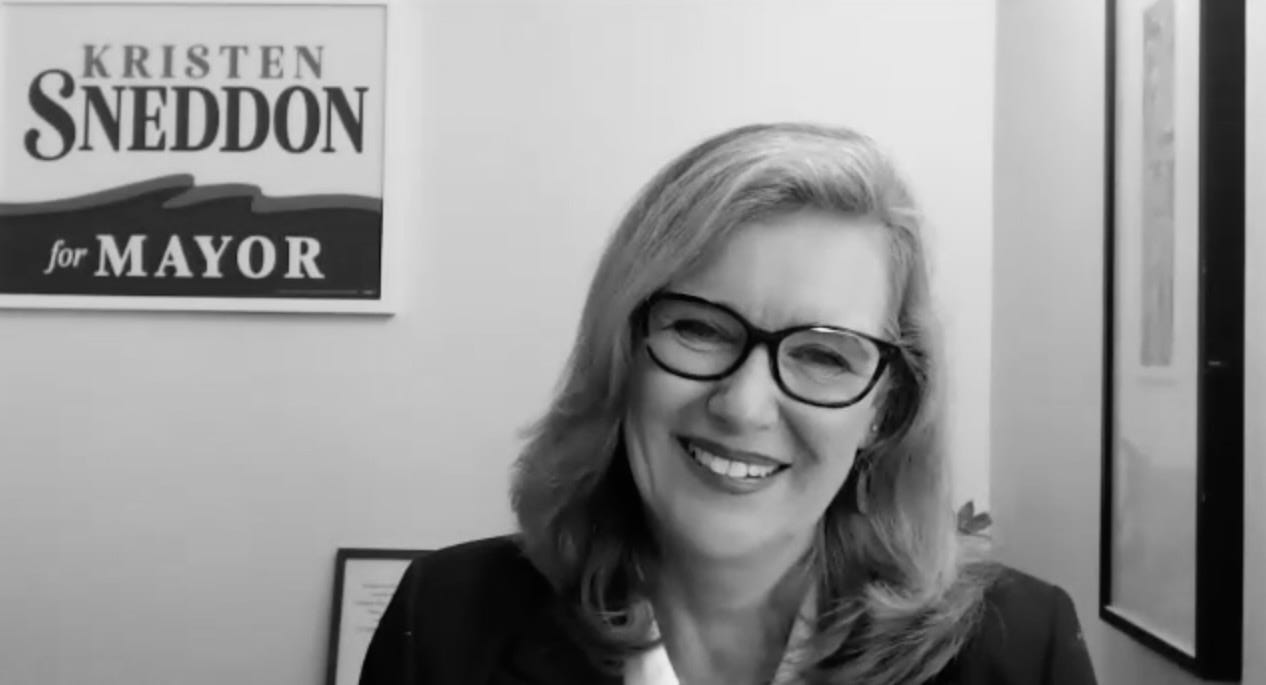
Kristen Sneddon, rejecting the maxim that Santa Barbara’s mayor is just a ribbon-cutting council member, says she would be a vocal and visible champion for the city, completing delayed projects and pushing back against the Trump administration.
Santa Barbara needs “a strong mayor in a weak mayor system,” the two-term council member said in an interview Sunday, implicitly criticizing retiring incumbent Mayor Randy Rowse as she asserted that the office has substantial unlocked potential — as a public bully pulpit, a hub of City Hall legislative strategy and a consensus-building clearinghouse for clashing community interests.
Sneddon told Newsmakers that most people believe Santa Barbara is headed in the right direction, based on her conversations with voters across the city, but want a mayor who will move ahead on “stalled out” projects like the State Street Master Plan and the endlessly debated rent stabilization ordinance — jabbing at chief rival and council colleague Eric Friedman for consistently voting with Rowse and blaming them for a lack of progress on bogged down city policies.
“People in Santa Barbara for the most part are happy with how things are, but they want to see motion, forward motion — they’re frustrated with how things get stalled out,” Sneddon said in her first in-depth interview of the campaign.
“In a weak mayor system, as we have, you need a strong mayor — a strong mayor who can make more of the position,” she added. “And I will say that it has not been fully embodied in the way that it could be.”
“I really believe that I’m the person for the moment right now,” Sneddon told Newsmakers.
Under Santa Barbara’s system of local government, the mayor is the only one of the seven city council members elected at large, with the others chosen in six neighborhood districts. Under the city’s “weak mayor” charter, it is City Administrator Kelly McAdoo, not elected officials, who wields direct power and authority over the bureaucracy and day-to-day management of more than 1,000 public employees and a total budget of $730 million.
But Sneddon said that as mayor she would be more assertive in working with the administrator, more collaborative in working closely with council colleagues about their concerns and legislative agendas, and more active in building community consensus by forming “a mayor’s cabinet of community members from different perspectives, different areas.”
“The mayor has the purview to set the agenda,” she said. “That is not something that has been done.”
State of play. Eleven weeks before the Nov. 3 election, the liberal Sneddon is still considered the front-runner in the mayor’s race, in part because she has the Democratic Party endorsement in a city with a heavily Democratic electorate, in an even-year midterm election that nationally will be a referendum on Donald Trump, whose public support has plummeted.
Friedman, however, shook up the race recently when campaign finance reports disclosed that he is outraising Sneddon 3-to-1. Sneddon also could lose votes to former school board president Wendy Sims-Moten, a fellow progressive who confirmed last week that she is running. Matt Kilrain, a waterfront denizen who won 131 votes in the 2021 mayor’s race, also is on the ballot.*
Among other factors, the long-running and contentious debate at City Hall over rent control — in the form of a rent stabilization ordinance scheduled to be back before council on Sept. 22, days before ballots are sent to voters — also could prove pivotal.
As a political matter, rent control is for Sneddon both a benefit and a liability. Although renters represent a majority of the city’s population, homeowners constitute a sizable portion of the electorate. With landlords and real estate interests expected to line up behind Friedman, Sneddon’s closest ally on rent stabilization is council member Wendy Santamaria — herself a tenant activist — who takes the most hardline positions on the issue and has become the most polarizing figure at City Hall.
With the council divided 4-3 on the issue, several of Sneddon’s comments were notable about several key issues involving rent stabilization, a month away from members casting decisive votes.
On the question of which units should be exempted from the ordinance, Sneddon offered a categorical statement in support of a list of exemptions proposed by the Housing Authority. On the question of what calculation should be used to determine a cap on rent increases, Sneddon said she is firmly committed to a 3 percent ceiling, but less so to using 60 percent of the Consumer Price Index as an annual alternative, which tenant groups favor. “I agree, 60 percent of CPI is hard,” she said. “And I’m hearing that a certain percentage, really 3 percent — I’ve heard, even from staunch people who don’t want to see this pass at all — that that would make the difference and make it doable.”
SB vs. Trump. Throughout the interview, Sneddon sought to contrast her vision of the mayor’s office with how Rowse has wielded it; notably, she said she strongly disagrees with the incumbent’s oft-stated belief that national and state issues should play no part in the business of city council, which instead should focus on clearly local concerns.
Sneddon said it is critical for elected officials to stand up publicly to the Trump administration on behalf of local residents menaced by the government’s mass deportation campaign and the brutality of immigration raids — as well as major cuts in federal programs for housing and other services.
“They are front and center,” Sneddon said of national political controversies and conflicts. “And right now, with the Trump administration, these issues with immigration and the terrorizing of people in our community — we don’t get to choose when to take that up. It’s here, front and center.
“I wish these weren’t things that were impacting Santa Barbara, or that we still got federal funding,” she added. “There are so many supportive services … the Housing Authority and Section 8 funding … mixed (immigration) status households that are going to lose their funding — we’re on the verge of hundreds of people who are going to lose their housing because of these (Trump) policies. And there are a lot of support services that are at risk.”
In the interview, Sneddon also reflected on her decade-long journey from political novice to City Hall insider; discussed her shifting relationship with the Democratic Party, which tried to force her out of her first race and now strongly backs her bid for mayor; highlighted her deep interest in climate, resilience and sustainability issues, which she said don’t get enough media attention; and blamed the current heated political atmosphere at City Hall on “problematic” rhetoric and “people making caricatures of each other.”
“I will say that what you’re seeing at council, at the public comments, or in the letters, are the two sort of polar sides,” she said. “But when I go door to door … I’m hearing from people who aren’t on this side or that side.”
“On all sides of this, we’re making caricatures of each other,” she added. “And if you step beyond that, we’re all neighbors and we’re in this community and we care.”
On the issues. In the Nov. 3 election, the balance of power at City Hall is on the ballot, amid races to replace Rowse and three termed-out neighborhood district representatives on the seven-member council. Our conversation with Sneddon is the latest in a summer-long series Newsmakers is doing with candidates for council and mayor. In the interviews, we ask the candidates for their views on four key issues.
Here’s a glimpse at what Sneddon had to say about them, lightly edited for clarity.
Rent control. “In the last nine years, rents have gone up 60 to 80 percent … senior women, the fastest-growing group newly experiencing homelessness. Vehicular homelessness in the county has gone from 600 people to 900 people. We’re losing working families, people can’t age in place … So this is one part of a multi-part approach and I think it’s really important — for property owners as well as for tenants, but the risks are much, much higher for tenants right now.”
State Street. “Every time it comes up — and I keep a tally — every time it comes up you have 70 to 80 percent of businesses, or the public, people, families who want to see it move forward … They want to continue to see it closed to cars, but improve the experience, take care of the e-bikes … have a block that is pedestrian only, no bikes at all. And my perspective is: we need to make movement, we need to have these things happen and be able to move forward. And until we actually try it, I don’t feel comfortable going back to 1997.”
Budget. Sneddon defended her decisive vote and the council’s 4-to-3 decision that effectively transferred several million dollars temporarily from budget reserves into a special housing fund, saying it was faithful to what voters wanted when they approved the Measure I sales tax increase. “As far as the money towards the Local Housing Trust Fund, it was basically on the ballot. That was part of the promise of Measure I, and to housing advocates who supported it and campaigned for it. Part of the promise of Measure I was that a small portion of that tax would go to affordable housing.”
Ranked-choice voting. Sneddon says she “fully supports” ranked-choice voting, as well as a system of runoffs among the top finishers in a primary, and putting the question of restructuring elections before voters.
Check out our full interview with Kristen Sneddon via YouTube below or by clicking this link. Our podcast is available on Apple, Spotify, or on SoundCloud. TVSB, Channel 17, airs the show every weeknight at 5 p.m. and at 9 a.m. on weekends. KCSB, 91.9 FM, broadcasts the program at 5:30 p.m. on weekends.
P.S. Apologies for confusion about 28 minutes in. Newsmakers had technical difficulty with Zoom app. Thanks to Harry Sneddon for IT rescue help.
* Correction: An early version of this post mistakently stated the number of minor candidates for mayor. There is one, not three.
Newsmakers’ Candidate Conversations. To offer Santa Barbara voters early introductions to contenders for four City Council seats, including Mayor, in the Nov. 3 election, Newsmakers is publishing one-on-one interviews with the candidates over the summer. Upcoming interviews include council candidates Jason Carlton and Anabella Lehne. Here is who we’ve spoken with to date:
Santa Barbara would benefit from a strong mayor capable of team building; and who has proven financial literacy skills. . How can Sneddon uphold her oath of office to uphold the Constitution and laws of the United States when against cooperation with law enforcement; and after gifting taxpayer money— our emergency reserves — to residents unlawfully here in a 6-1 vote? I don’t see any signs up promoting her in her D4 from Coast Village Rd across Alston, APS to the Mission. Her constituents seem to be Marty Blum, the Dem party, union bosses, and voters dependent on government hand outs. City is broke. County is broke.
We need ownership housing! Supporting more and more property tax exempt, rent control exempt government affiliated housing projects is costly to every property owning citizen and will ultimately lead to fiscal doom. Maybe that’s good. No more lifelong pensions for those lucky to be on government payroll with Fridays off.
So Councilwoman Sneddon is proposing a mayor’s cabinet that includes community members with different perspectives. That sounds good in principle. However, my experience, as a now-District 4 resident, has been that she is not particularly receptive to engaging in discussion when someone expresses a viewpoint that differs from hers.
Back in 2024, while waiting for the District 1 debate to begin at the Boys & Girls Club, I expressed my dissatisfaction with the closure of State Street. She seemed visibly miffed and abruptly ended the conversation. Based on that interaction, I did not come away with the impression that she was particularly interested in hearing a perspective that differed from her own.
I realize that one interaction is only one interaction, but it left me with a strong “my way or the highway” impression. That experience makes me wonder how genuinely receptive her proposed mayor’s cabinet would be to members who bring perspectives that challenge her own.