

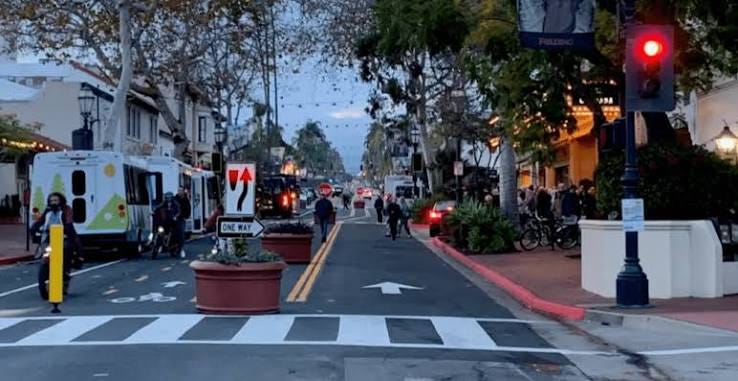
Six years after COVID, the City of Santa Barbara effectively maintains a blockade against shoppers who dare to arrive downtown by car — under the cover of “emergency” legislation that remains operative long after the emergency passed.
Now, downtown business owners have mounted a robust petition and letter-writing campaign to press the City Council to roll back key sections of the Municipal Code, which keep nine blocks of State Street sealed off from vehicular traffic.
Organized as the State Street Business Alliance, the ad hoc coalition has gathered more than 650 signatures and personal statements on a petition urging the council to repeal “Title 31,” a 2023 measure that codified the street closure, which started during the first term of Donald Trump as a pandemic economic recovery mechanism, allowing restaurants to expand outdoor operations.
“We’re fully supportive of any plan that the council or the city comes up with that works for everybody — we just want to be included,” said Colleen Macey, the driving force behind the Alliance and owner of Santa Barbara Interiors on East Figueroa Street.
“We’d like to have a voice,” Macey told Newsmakers. “We’d like somebody to say, ‘How is this going to affect the small businesses, and what can we do to help keep them going?’ Because this street closed is not good for business. I see things on social media and everywhere else where people say, ‘Oh yeah, the businesses are doing much better with the street closed.’ That is just 100 percent not true.”
The sudden emergence of the Business Alliance is the latest twist in a long-running soap opera over access to downtown Santa Barbara - a political drama defined by the dramatic rise of electric bicycles, the growing influence of bicycle lobbyists at City Hall, and the unavailing — if persistent — complaints of Mayor Randy Rowse and his allies, who argue that the street closure bears significant responsibility for the decline of retail and other economic activity downtown.
The most organized business community pushback to date against the political influence wielded by bicycle advocates over liberal elected officials comes amid ongoing maneuvering around the 153-page State Street Master Plan, which the City Council adopted in principle in April.
Left unresolved in that decision were a host of specific and nagging questions about where, when, and how vehicular traffic — if any — might return to State Street, an outcome long sought by many business operators and local residents (not to mention septuagenarian podcast hosts who cheat death at the wheels of e-bikes every time they venture downtown; we name no names).
Among other downstream decisions, council members must determine how the restrictions contained in Title 31 will apply — or not apply — to the master plan before the ordinance is scheduled to expire at the end of the year.
“It is a completely moving target,” said Cass Ensberg, an architect and member of the Historic Landmarks Commission who has been one of the community’s most passionate and persistent voices on State Street’s future. “I don’t know if this Tuesday the intention will be to extend Title 31 for a year, two years, three years, whatever.”
“What we are wanting to bring to the table is the voices that we feel have not been heard,” she added. “But we would like to see Title 31 repealed and the street reopened as soon as possible in order to generate more revenue for the city and provide more support for businesses.”
Check out our conversation with Colleen Macey and Cass Ensberg via YouTube below or by clicking this link. Our podcast is available on Apple, Spotify, or on Soundcloud here. TVSB, Channel 17, airs the show every weeknight at 5 p.m. and at 9 a.m. on weekends. KCSB, 91.9 FM, broadcasts the program at 5:30 p.m. on weekends.
Image: The 900 block of State Street (Ryan P. Cruz photo for The Santa Barbara Independent).
Here is the text of the letter sent to City Council by the State Street Business Alliance:
Honorable Mayor and Members of the City Council,
We are business owners and members of the Santa Barbara community. We write this letter to respectfully ask that you carefully review the attached petitions and comments supporting the reopening of State Street. Our opinions are not outdated or isolated complaints. They are current comments within the last month from those of us who have experienced the consequences of the “temporary” closure firsthand that has extended now for six years. It is time to reopen State Street.
State Street was closed under extraordinary circumstances during the COVID-19 pandemic. Businesses and residents accepted this because we understood the need to respond quickly to an unprecedented crisis. However, six years later, the emergency is over, yet the temporary conditions imposed during that period continue to dictate the future of our city’s Main Street.
Title 31 was implemented and intended to provide temporary flexibility during the emergency by suspending normal processes and procedures specifically eliminating HLC design review and other regulatory requirements. Instead of returning State Street to its pre-pandemic condition and then evaluating long-term options, the City has effectively implemented a temporary emergency closure as the starting point for a permanent transformation. In doing so, the burden of proof has been reversed. Those who wish to restore State Street to its historic and functional condition are now being asked to justify reopening it, when reopening should have been the default once the emergency ended. Extraordinary powers are meant to address extraordinary circumstances. They were never intended to indefinitely determine the future of Santa Barbara’s Main Street.
Instead of economic renewal, many local businesses have struggled to survive, relocated, or closed their doors altogether. Storefront vacancies remain visible, accessibility has been reduced, and countless visitors and residents have stopped visiting downtown entirely.
The concerns we continue to hear from all age groups reflect a growing and widespread sentiment throughout Santa Barbara that the prolonged closure has created unintended consequences that are harming the vitality, accessibility, and economic health of our downtown district.
What was initiated as a temporary closure has evolved into a long-term expensive experiment. It is critical that community leaders honestly recognize the negative impacts of the closure and listen to the voices of everyone, especially those who are and have been most affected.
State Street is a critical transportation corridor and one of the most important circulation routes in Santa Barbara. As a public right-of-way, it is required to accommodate residents, businesses, employees, visitors, emergency services, deliveries, individuals with mobility needs, etc. Any long-term decisions regarding State Street must recognize its essential role in moving people and goods throughout the city. While it can support recreational and community activities, its primary function is to serve as a vital transportation artery that provides safe, efficient, and accessible passage for all.
Local businesses depend on visibility, convenience, and customer traffic to survive. When access is challenging, customers choose other destinations. Every empty storefront, every struggling business, and every lost job weakens the economic vitality of Santa Barbara. Small businesses are the backbone of our community, and they deserve a City Council that prioritizes their success and listens to their concerns.
State Street belongs to everyone and must be welcoming to all regardless of age or transportation preferences. It should be accessible to people with disabilities who need convenient drop-off locations and nearby parking. It must work for families with children, visitors exploring our city, residents running errands, employees commuting to work, cyclists, pedestrians, and business owners alike.
Golf carts are not a substitute for true accessibility. They do not meet the real needs of seniors, people with disabilities, families, workers, visitors, or customers who rely on dependable transportation, convenient drop-off areas, accessible parking, and clear routes to reach downtown businesses and services.
The current circulation pattern is confusing, strangled, and unnecessarily convoluted without our main street functioning as a main street. Drivers are forced to circle surrounding blocks, burn more fuel, spend more time searching for access, and navigate frustrating detours just to reach businesses that should be easy to visit. This does not reduce emissions. It simply moves traffic onto neighboring streets and creates more idling, more congestion, more confusion, and more frustration.
Cars moving slowly and predictably at 20 miles per hour on State Street were a safer and more functional option than the current environment, where unregulated e-bikes, scooters, delivery vehicles, pedestrians, and service vehicles compete for space in a corridor with unclear rules and inconsistent enforcement.
Many residents no longer feel comfortable or safe on State Street. What was intended to become a vibrant pedestrian experience has too often become an attractive nuisance, drawing behavior that contributes to vagrancy, disorder, and a reduced sense of safety. When downtown feels unsafe or neglected, residents and visitors stop coming. When people stop coming, businesses suffer, vacancies grow, and the entire community loses a vibrant and healthy economy.
Many residents who once frequented downtown no longer do resulting in reduced sales, and difficulty attracting new investment. Commercial brokers and retailers consistently evaluate traffic counts, visibility, access, and convenience when deciding where to invest. When downtown Santa Barbara is removed from consideration because it lacks those fundamentals, the entire community loses opportunities, and the city loses vital revenue.
The City Council’s responsibility is to serve the entire community and to ensure that Santa Barbara remains safe, accessible, economically healthy, and attractive. Strong infrastructure, sound planning, economic vitality, public safety, and accessibility are fundamental responsibilities of local government. Decisions regarding State Street must be evaluated through those lenses to ensure balance and that the requirements are met.
A healthy downtown is not measured by ideology. It is measured by whether businesses are thriving, whether residents feel safe and welcome, whether visitors return, and whether all members of the community can easily access and enjoy the city center.
State Street’s beauty, charm, and historic character were not created by closing it to traffic. Those qualities existed for generations and helped establish Santa Barbara as the American Riviera and one of the most admired communities in the world. Many residents question why so much time, effort, and public resources continue to be devoted to reinventing a place that was already exceptional and widely beloved.
The evidence is clear that many residents believe the current model is not meeting those objectives. What was implemented as a temporary measure has now remained in place for six long years – well past “temporary”.
State Street was not broken before it was closed. The closure created many of the challenges we face today. It doesn’t need to be fixed or reenvisioned, it just needs to be reopened as the flexible street it was for decades. People want their traditional State Street back.
Repeal Title 31 and reopen State Street. Restore pre covid function and Historic Landmarks Commission authority over our historic district. Support local businesses and the financial health that comes from each successful business. Bring life back to the heart of Santa Barbara.
With urgency and respect,
Colleen Macey and Cassandra Ensberg /State Street Business Alliance