
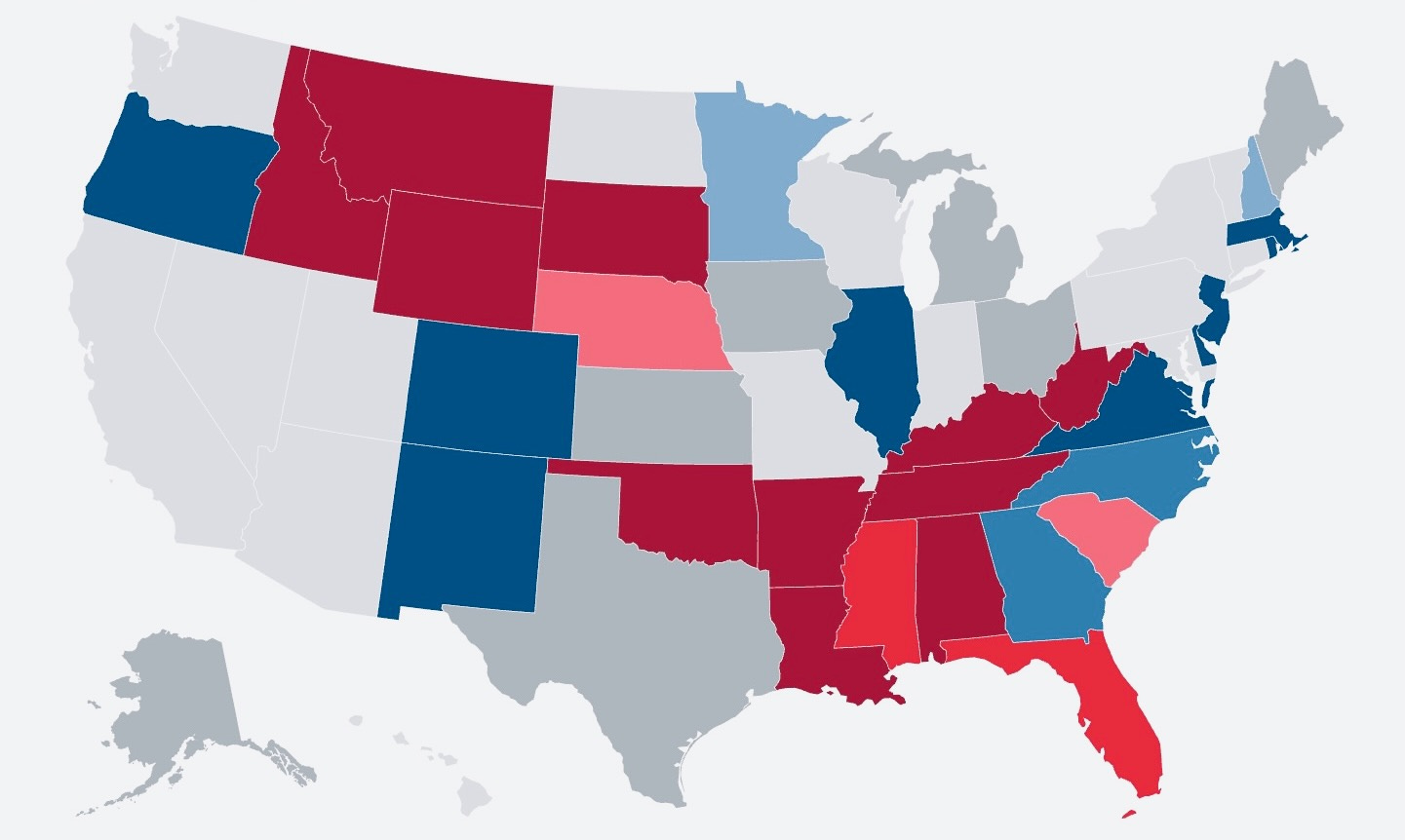
(Editor’s note: Donald Trump is more unpopular than any president in history right before a midterm election, and Democrats are heavily favored on Tuesday to win back control of the House of Representatives. A crucial question now is whether they can also capture the Senate, a possibility thought impossible a year ago. That would give them much more power to disrupt his agenda of corruption, chaos and cruelty, most importantly by blocking his court, cabinet and foreign service nominations. Via gift link, here is the authoritative Cook Report’s analysis of the most critical Senate seats in play. —jr).
By Jessica Taylor /The Cook Political Report
Control of the Senate is hanging in the balance, with seven key races still within the margin of error, giving both parties a path to the majority in 2027.
But given the dismal national political environment for Republicans — and the fact that Democrats have multiple scenarios to gain the four seats they need to flip the chamber (of the seven seats sitting in Toss Up, six are held by Republicans) — we see Democrats as the slight favorites.
We are keeping seven races in our Toss Up category as of today because, frankly, we do not know how they will break in the closing days of the election. And after talking to scores of plugged-in strategists on both sides of the aisle who are tracking the races exhaustively, they don’t either.
In our writeups for each state below, however, we outline where we see these races trending, which informs our belief that Democrats are better positioned to win the majority than Republicans are to keep it.
Some polls have tightened in the final weeks as voters come back into their partisan camps, while other races appear to be moving away from the GOP. This may not be a linear election, with all of the Toss Ups breaking one way, but instead one in which candidate quality bucks historical statewide trends or the overall political environment.
That’s why we also see a plausible (though less likely) outcome for Republicans to protect their majority, especially if there is a significant polling error that has undersampled GOP voters.
We are keeping our latest range unchanged — we expect Democrats to pick up between two and six seats. Two additional ratings are also shifting in Democrats’ direction: Nebraska from Likely to Lean Republican and Florida from Solid to Likely Republican.
Impact of Iran War. How did we get here, in a cycle where Democrats once faced “herculean” odds to take back the Senate?
Looking back, the Iran War and its subsequent dramatic rise in gas and diesel prices was a key turning point. But President Donald Trump’s approval ratings had started to recede even before that, including in deep red states. Democrats’ strong recruits in Ohio, Alaska and Kansas put red states within reach, while Republicans fumbled with sub-par nominees in Georgia, North Carolina and Texas. Democrats have had their own struggles with candidates in Maine and Michigan, though.
Ultimately, Democrats are poised to capitalize on Trump’s tumbling image and discouraged base. The true test may be whether even the best GOP candidates of the cycle — in Maine and Iowa — can survive a looming blue wave.
But in deep red states, Republicans have gone all in to convince their wary voters to come out on Election Day, which could exert enough political gravity to make Democrats come up just short. In nearly every Toss Up state, both parties have polling that shows the contests within the margin of error.
Here is our best take on where these races stand as we head into Election Day, from most to least likely to go Democrats’ way:
Democrats’ path to the majority
North Carolina will be Democrats’ first pickup of the night, with Republicans having all but ceded the state weeks ago and abandoned former RNC Chairman Michael Whatley in his uphill quest against former Democratic Gov. Roy Cooper. Cooper has been on about as much of a glide path as you can be to the Senate. If this is a double-digit win, Democrats feel good about their chances elsewhere on the map.
Rating: Likely Democrat
Republicans and Democrats have very different views of the race in Maine. Despite being burned in the past by polls that underestimated Sen. Susan Collins, Democrats are cautiously optimistic that their private polling and public data is right this time, given how steadily Collins’ approval has declined. Republicans believe that Collins’ historical resilience with swing voters in the state will once again kick in to help her outrun the national headwinds. And private GOP polling shows a closer race than Democratic or public polling. Democrat Troy Jackson has not been one of Democrats’ stronger candidates (he was a midseason replacement, after all). But the cost of living in Maine, Trump’s deep disapproval in the state, and lingering anger over Collins’ vote for Supreme Court Justice Brett Kavanaugh may cause even onetime Collins voters, particularly older women, to pull the lever for Jackson nonetheless to send a message to Trump.
Rating: Toss Up
It wasn’t that surprising when the New York Times reported on Wednesday that former Rep. Mary Peltola’s campaign and national Democrats were behind getting a second Dan Sullivan on the ballot. But will voters care and will the “fake” Dan J. Sullivan pull enough votes away from Sen. Dan S. Sullivan to help Peltola win? Republicans sound pessimistic about this race, given Sullivan’s poor approval ratings — but Alaska is another state that’s notoriously hard to poll. If this race goes to ranked choice voting, as we expect, the outcome won’t be known for weeks. The bigger question is whether or not the Senate majority hinges on Alaska. We’d probably put a pinkie on the scale for Peltola right now, but not enough to shift the prediction in Democrats’ favor.
Rating: Toss Up
Surprisingly, Texas may be the next state to flip after North Carolina and Maine. Democrat James Talarico has consistently led the baggage-laden Republican Ken Paxton. The Texas attorney general has also run a subpar campaign, with Elon Musk and the Senate Leadership Fund having to bail him out to the tune of $180 million, which doesn’t go as far as the hard dollars Talarico impressively raised. Latinos and even disgruntled Republicans are trending toward Talarico by enough to help him pull off the upset. But there has been some late tightening in polling, and some GOP strategists are hopeful that if Gov. Greg Abbott can win by five points or more, he’ll pull Paxton over the finish line. If Abbott barely wins, though, Texas could finally turn blue. We’d rather be Talarico in this final stretch.
Rating: Toss Up
After Texas, Ohio is the next most vulnerable GOP-held seat on our list. Appointed Sen. Jon Husted has not run a particularly impressive race, and he’s also been hurt by Vivek Ramaswamy’s spiraling gubernatorial campaign, whose chances we recently downgraded after his controversial ad. Polling from both parties still shows the race as a coin flip. GOP hits against former Sen. Sherrod Brown’s longevity in politics have helped tighten the race in Republicans’ direction in recent weeks, but we’d still give Brown a very slight edge here.
Rating: Toss Up
We believe that Kansas is more likely to flip than Iowa, and so do most Republicans we’ve talked to. Sen. Roger Marshall has run one of the worst campaigns this cycle, with national Republicans rushing in at the end to try to bail him out. Enter Rev. Adam Hamilton, who many Republicans believe is one of Democrats’ best candidates this cycle. Add in a worsening environment for the GOP and a hard-hit agriculture industry, and we wouldn’t be shocked to see a Democratic upset here on election night — even in a state that voted for Trump by 16 points and hasn’t elected a Democrat to the Senate since 1932. Marshall would have no one but himself to blame, and Hamilton has the momentum at the end.
Rating: Toss Up
Both Democrats and Republicans privately believe that if only one GOP candidate in our Toss Up states hangs on, it will be Iowa Rep. Ashley Hinson over Democratic state Rep. Josh Turek. The key here may be Democratic state Auditor Rob Sand’s margin of victory in the governor’s race and if it’s enough to pull Turek, a former paralympian, over the finish line. Hinson has shown herself to be a talented communicator who deftly distanced herself from some of Trump’s most unpopular policies, but the president is still deeply underwater in the state. Private and public polls show the race is a dead heat, with each side believing their candidate is up, but within the margin of error.
Rating: Toss Up
Republican offensive opportunities (mostly) out of reach
Michigan should have been a relatively easy hold for Democrats in this environment, given that it’s a swing state that has historically moved a few points to the left in midterm cycles. But Democrat Abdul El-Sayed has never fully consolidated the Democratic base, particularly Black and Jewish voters. Although public polls show that El-Sayed has opened up a slight lead over Republican Mike Rogers, we’re wary of the most bullish surveys for Democrats in the state, especially after a major polling miss in the August primary. Democrats ultimately feel confident that El-Sayed will pull the win out, while Republicans maintain it’s still within reach of an upset in the final days, particularly as Rogers continues to relentlessly try to tie El-Sayed to terror groups. If enough Democrats skip the ballot or split their ticket for Rogers, there could be an outcome that goes against the national mood, but El-Sayed likely has a slight edge in this final stretch.
Rating: Toss Up
After a brief scare, Democrats again feel confident in holding the New Hampshire open seat, and polls show Rep. Chris Pappas up mid-to-high single digits over former GOP Sen. John E. Sununu. Some Republicans still hold out hope that the Sununu name and the state’s history of ticket splitting could produce an upset that would offset other potential losses, but that dream has faded in the last month.
Rating: Lean Democrat
In Minnesota, Lt. Gov. Peggy Flanagan will probably underperform Sen. Amy Klobuchar in the governor’s race, and Republican Michele Tafoya has run a very competent campaign. But the fundamentals in Minnesota simply create too tough an environment for a GOP candidate. We don’t expect this to be a double-digit race (as a recent New York Times/Siena poll showed), but Democrats are right to feel comfortable here.
Rating: Lean Democrat
And ultimately, Georgia never ended up being the race Republicans had hoped to run against Democratic Sen. Jon Ossoff after outgoing Gov. Brian Kemp passed on a bid. The GOP nominee, Rep. Mike Collins, has been one of the most underwhelming candidates of the cycle, never even airing a general election ad. The only question that remains is whether Ossoff’s margin will be large enough to lift former Atlanta Mayor Keisha Lance Bottoms to victory.
Rating: Likely Democrat
The Blue Tsunami Warning States
This is where to watch to see if the Democratic wave is a Category 3 storm or if it intensifies to a Category 4 or 5 hurricane. If it does, Democrats could pile up wins in places they have no business being competitive.
Despite a New York Times/Siena poll on Wednesday showing a tied race in South Carolina between appointed GOP Sen. Darline Graham and pediatrician Annie Andrews, we still believe this one finishes just out of reach for Democrats. Even though private GOP polling shows a close race, both parties believe that the race will ultimately break Republicans’ way. Nonetheless, Graham has run an underwhelming campaign since her brother’s July death, and Andrews has taken advantage of the vacuum. If Andrews does pull off the upset, it will be because enough Republicans either defected to the libertarian on the ballot, wrote in Graham’s primary opponent Rep. Ralph Norman (whose own son wrote an op-ed saying he would vote for Andrews), or enough GOP voters simply left their ballot blank. This could be an early barometer for Democrats on election night — if it’s even within a few points, gale force winds could be forming for Republicans.
Rating: Lean Republican
We’ve had mixed feelings about the Nebraska contest for months now, doubting that independent Dan Osborn could pull off a second sneak attack against a stronger candidate in Sen. Pete Ricketts than his 2024 opponent, Sen. Deb Fischer. But the environment is worse this time around for Republicans, and Democrats believe they finally landed a salient hit against Ricketts for pardons of violent criminals as governor. Privately national Republicans acknowledge the race has tightened somewhat in the final week. A poll from the GOP firm Echelon Insights also showed a closer-than-expected one-point race, Ricketts 47%-Osborn 46%, so it’s not just Osborn’s internals painting a rosier picture. But there have been enough conservative outside groups that are friends of the wealthy Ricketts family coming in, from SLF to crypto, that we expect the race ultimately breaks the GOP’s way despite the headwinds.
Rating: Move from Likely to Lean Republican.
Mississippi has gotten a lot of attention and ink in the past few weeks, and Republican Cindy Hyde-Smith even doubled down recently on her much-mocked comments that voters should simply choose a cheaper protein than beef. Democrat Scott Colom has run an admirable race, and Democrats are hoping that Black turnout surges enough to keep the race close and set the stage for more competitive races in the Deep South in future cycles. But Republicans believe their late influx of cash has fixed their problems and bailed out another incumbent who got caught napping.
Rating: Likely Republican
We are putting Florida on our board as well. A New York Times/Siena poll on Wednesday showed the contest between appointed Sen. Ashley Moody and Democrat Angie Nixon within six points, 50%-44%. Nixon would be faring better if she hadn’t aligned herself with democratic socialists, and this may end up being a real candidate miss for Democrats in a Trump +13 state — albeit a very expensive one they may not have been able to put online regardless. Moody has a history of running ahead of the partisan baseline, and ultimately we don’t think she’s in any real danger. But if the race is closer than expected, it deserves to be out of our solid column.
Rating: Move from Solid to Likely Republican
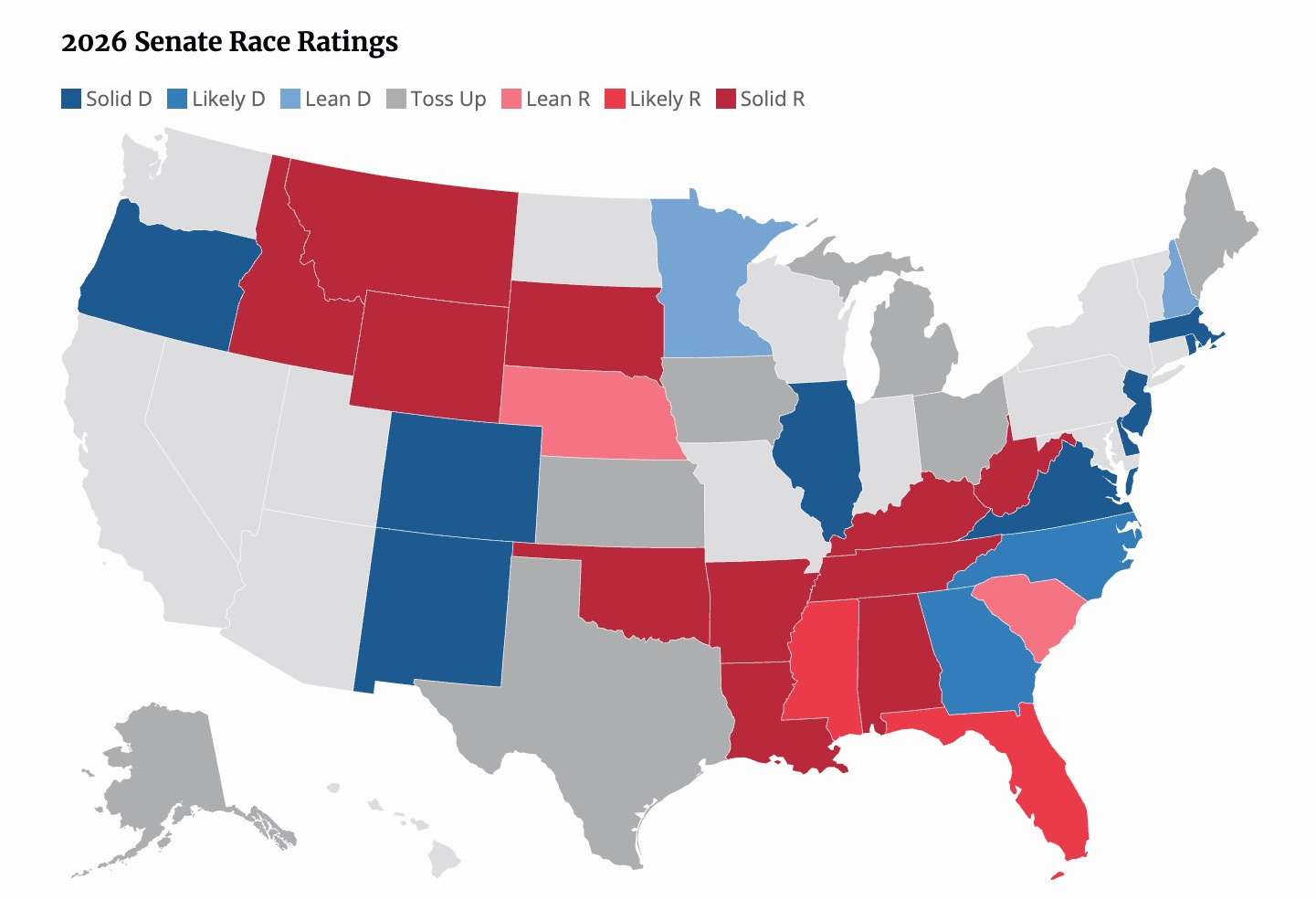
Images: The Cook Political Report’s latest analysis of 2026 midterm election Senate map.
Susbcribe to The Cook Political Report here.