


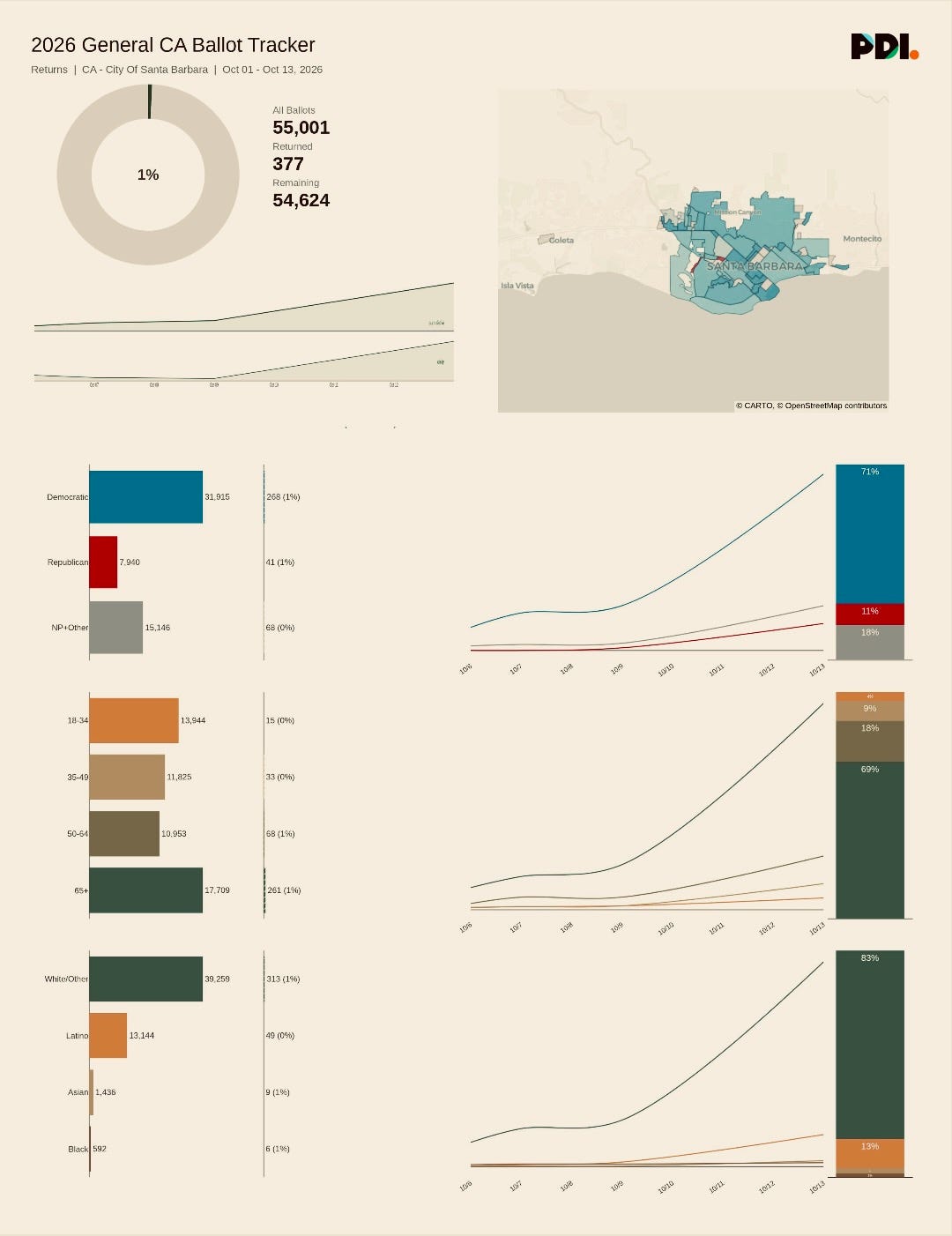
Three weeks before Election Day, a total of 337 voters in the city of Santa Barbara - among a registered electorate of 55,001 - have so far returned their ballots, the large majority of them older, white Democrats.
That’s the first report from the PDI, California’s leading political data firm, whose dispatches Newsmakers will follow closely between now and Nov. 3.
Although insignificantly preliminary, the PDI report underscores a fundamental truth about this year’s wide-open campaigns for mayor and three city council seats: Amid the verbal and visual cacophony of debates, forums, mailers and house signs (not to mention media coverage) the ground on which they all are competing already has been shaped by who is registered to vote, how these voters have behaved in past elections, and what the rules are that determine where and when candidates run.
In Santa Barbara, those fundamentals are easy to overlook, yet they quietly determine which messages resonate, which neighborhoods matter and which paths to victory are realistic.
The three charts below lay out that foundation: the partisan makeup of the city’s electorate, the results of the most recent mayor’s race, and the way that the recent reform moving the city to even-year election changes the makeup of the electorate.
I. Voter registration
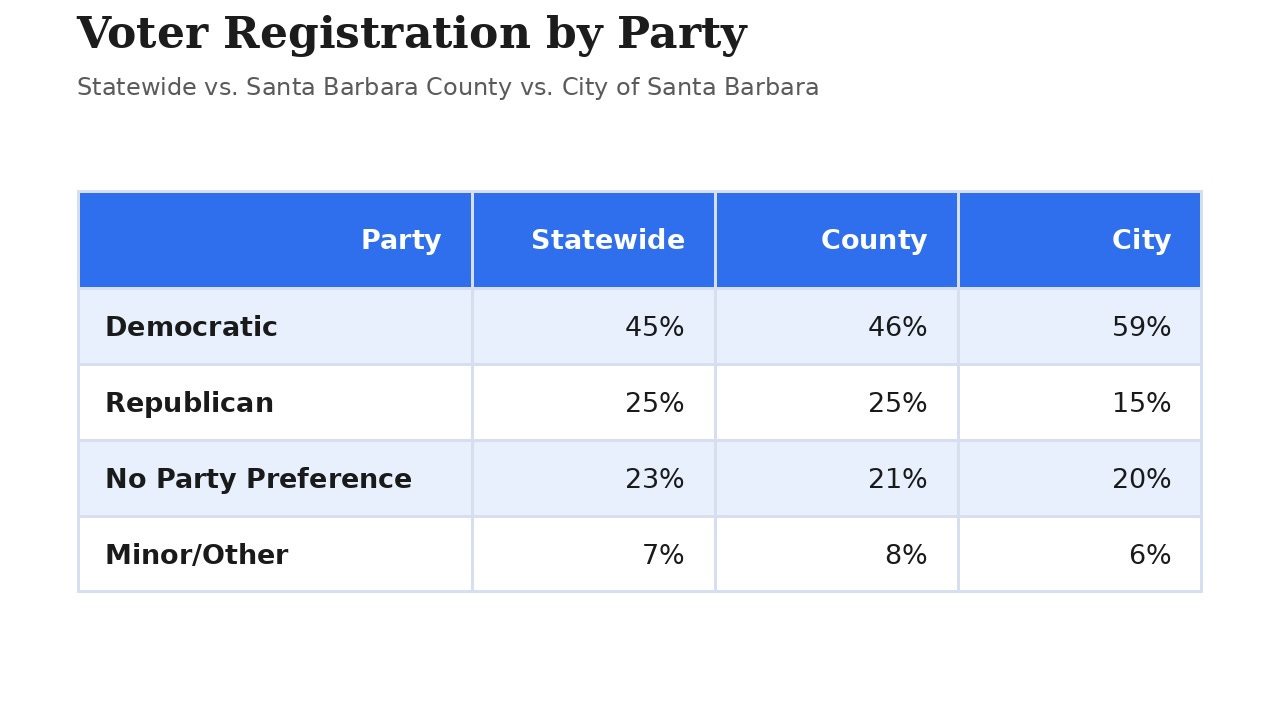
The electorate in the city of Santa Barbara is decisively Democratic — 30 per cent more so than both the county and the state - so the party’s endorsement, mailer and campaign volunteers represent a major asset for the candidate who gets it, serving as an important signifier for Democratic voters who may be undecided, or don’t follow political affairs closely, and trust the party’s seal of approval.
II. The 2021 mayor’s race
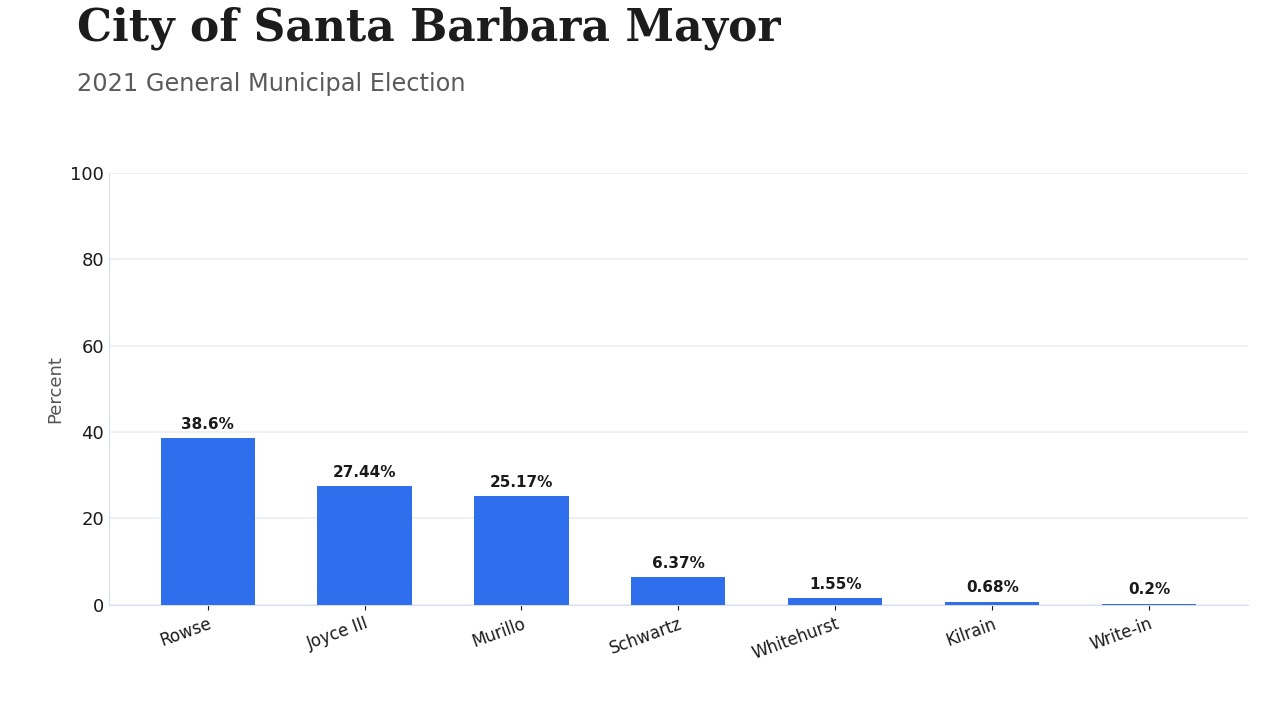
Randy Rowse, a political independent, won the city’s last mayor’s race in 2021 with a plurality - largely because three Democrats split their party’s voters.
Incumbent Mayor Cathy Murillo finished third in her re-election bid - despite carrying the Democratic party endorsement - when fellow Democrat James Joyce edged her out with an insurgent campaign that offered party voters an alternative to the unpopular incumbent. Pro-business Democrat Deborah Schwartz also won a small but significant slice that further splintered the party’s overall vote share.
III. The shift to even-year municipal elections.
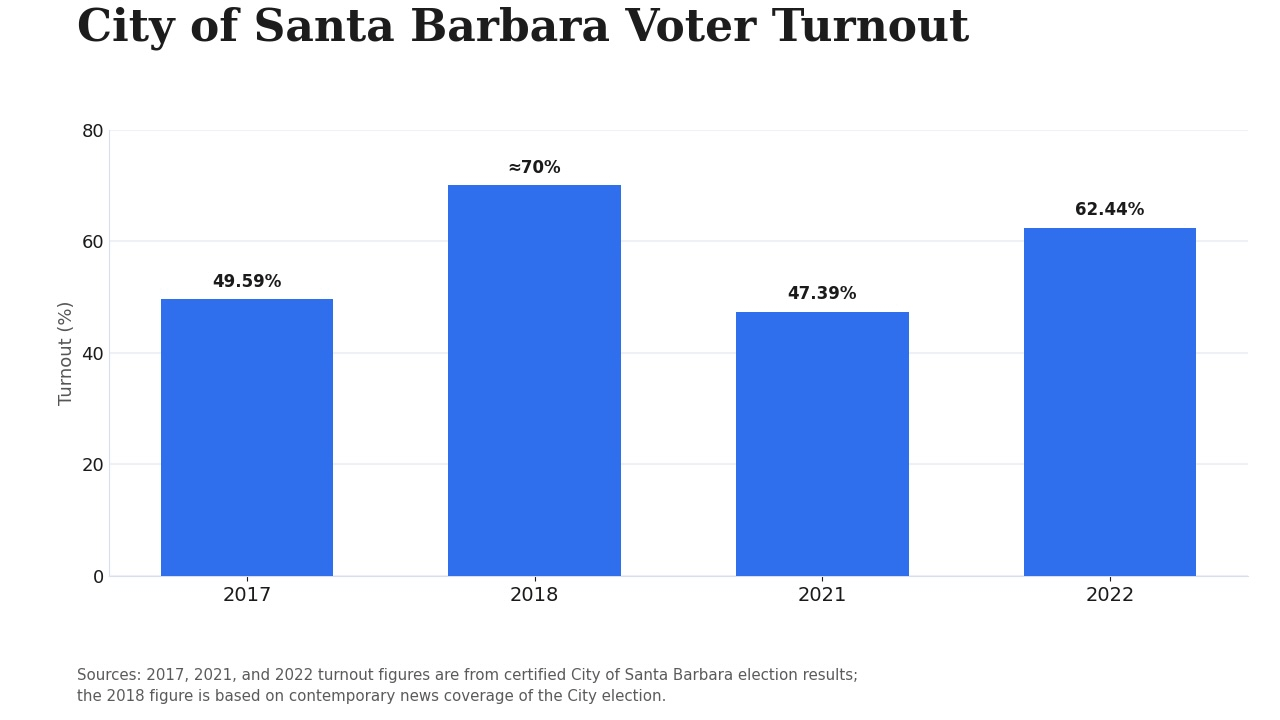
The 2026 election marks the first time since 1958 that city voters will select a mayor and council members in an even-year election.
The change comes about because of Measure B, approved by voters in 2018, a second major change that transformed Santa Barbara’s political landscape, following the 2015 adoption of district elections, under which the mayor became the only member on the seven-seat City Council to be required to win citywide.
Measure B is a consequential change: city voter turnout increased between 15 and 20 percent in even-year, national midterm elections, in years that followed odd-year municipal balloting for council seats and mayor. The even-year balloting drew more younger, more liberal voters who are more likely to be renters than homeowners, according to Democratic strategists, who say the cohort is more responsive to progressive policies and messaging.
Bottom line. In the 2026 mayor’s race, there is no candidate, like Rowse, running evidently in the independent lane. Instead the three major candidates - council member Kristen Sneddon and Eric Friedman, plus former school board president Wendy Sims-Moten - all are lifelong Democrats.
As a political matter:
Sneddon, who captured the Democratic Party endorsement in large part because she led the charge for the city’s contentious rent control ordinance, is best positioned to take advantage of the boost in turnout from younger, liberal voters, as well as the considerable campaign assets provided by the party organization.
Friedman, who was backed by the Democrats in his first race in 2017, lost any chance at the endorsement because he opposed the rent stabilization law. As the moderate in the race, he appeals to Rowse’s voters, while trying to peel off enough Democrats who seek an alternative to Sneddon to edge her out at the wire.
Sims-Moten is a wild card, who has scant financial or organizational support for her campaign, but whose passion about social justice issues and stature as a civil rights leader seem likely to attract more voters from Sneddon’s liberal base than from Friedman’s.
Don’t forget to vote.
P.S. Here’s a look at the first page of the aforementioned first PDI report on ballots returned by voters in the city of Santa Barbara.
Data sources: California Secretary of State, SB County Clerk, Recorder, Assessor and Elections office, and local media election coverage. Charts drawn by Anthropic AI agent Claude.