
By Jonathan V. Last /The Bulwark
Over the last week, agents of the federal government have killed two people on the streets of America.
We should say their names: Lorenzo Salgado Araujo; Johan Sebastián Guerrero.
These men were not armed. Araujo was in the country illegally, but was not the target of the operation that ended in his public execution. Guerrero was in the country legally when he was executed by agents of the state.
In America, we have become inured to incidents in which law enforcement kills civilians. The idea that law enforcement officials can use deadly force at the drop of a hat is accepted by the general public.
But what the federal government has been doing to people assumed to be immigrants is different from normal police brutality. It is a targeted campaign.
We are witnessing, for the first time since Jim Crow, American death squads.
I understand if that sounds like an exaggeration. But that’s only because we are inside the story and have become acclimated to the horror.
When crimes against humanity start happening, the people on the inside are often the last to understand how horrific the situation is.
So let me tell you a story to help you understand how our situation looks to outsiders.
Story corner. Once upon a time there was a democracy. It was a young country, but a reasonably sophisticated one. It was a constitutional republic, with separation of powers, the rule of law, the whole nine yards.
They were upwardly mobile and making economic strides. But they had problems, like every country. One of their problems was the drug trade.
A politician rose to power arguing that drugs were ruining the country. That drug dealers and drug users were destroying everything the people—the silent majority—held dear.
This politician came from a wealthy family but presented himself as a populist hero of the working class. He was unapologetic about his hatred of drug users. “I would be happy to slaughter them,” he told voters.
The New York Times, in a profile years later, would describe him this way:
[H]is draconian justice and coarse manner have earned him widespread condemnation. . . .
He has alienated many with outrageous comments and irrational behavior, yet remains wildly popular.
This politician ran for president and campaigned almost exclusively on the scourge of drugs. He had a policy prescription to deal with the problem: He would unshackle the police and turn them loose on the streets to deal with the drug problem while also encouraging civilian militias to do the same.
“Forget the laws on human rights,” he said during his campaign. “If I make it to the presidential palace, I will do just what I did as mayor. You drug pushers, hold-up men and do-nothings, you better go out. Because I’d kill you.” He promised to use the pardon power of the presidency to immunize police who killed on his behalf from future prosecution. He called the pardon power one of his “weapons.”
He had a message for the news media, too, after a disturbing act of violence against a reporter: “Just because you’re a journalist you are not exempted from assassination, if you’re a son of a bitch.”
The politician won and became president. Soon after his election he went to a rundown neighborhood and addressed the country: “If you know of any addicts, go ahead and kill them yourself,” he said.
Another passage from that New York Times profile:
A psychological assessment of [President X], prepared in 1998 for the annulment of his marriage, concluded that he had “narcissistic personality disorder” and a “pervasive tendency to demean, humiliate others and violate their rights.”
Once the politician was sworn in as president, the killings started.
Killing people in the streets. The police killed people on the streets. Civilian militias killed people on the streets. Everyone who was shot was labeled either a drug dealer or a drug user.
There was no proof offered, though. The police would find someone they claimed to be a drug user, kill them, and move on. No investigation. No accountability.1
This happened every day, because drug users were seen as vermin who were poisoning the blood of the country. Many of the people who were killed were not, in fact, either drug dealers or drug users.
The people of this little democracy didn’t mind terribly. They were mostly amused by the antics of their president—he was so outrageous! And, like I said up top, these things can be hard to see clearly from the inside.
People outside the country, however, recognized exactly what was going on.
These were death squads.
Some of the death squads were agents of the state specifically instructed by the president. Some of the death squads were freelance civilians. The rule of law was gone, but not in a random way—it was a targeted campaign against a particular population that treated minor legal infractions as capital offenses.
People inside the country thought that maybe their president had gotten carried away, or been a little too bombastic. People outside the country understood that they were witnessing something worse.
The view from abroad. International media outlets put together documentaries about what was happening.
The European Union urged the country to pay attention to the human rights abuses that were taking place on its streets.2
The International Criminal Court indicted the president for crimes against humanity.3
The entire world was aghast that this once normal, peaceful constitutional republic became a place where agents of the state routinely murdered unarmed civilians on the street. A home to death squads.
By now you recognize that we’ve been talking about Rodrigo Duterte and the Philippines. And no, the parallels aren’t exact. But the similarities are uncanny?
This is not normal. The point of this story, however, isn’t to argue that Trump=Duterte, same-same. The point is that during Duterte’s reign, people inside the Philippines thought they were experiencing quasi-normal political life.
But the rest of the world was able to see the situation more clearly.
I wonder if it’s the same way with our ICE death squads.
Maybe, even though we’re treating these killings as normal, the rest of the world has a clearer sense of what’s going on. Maybe the rest of the world reads about what is happening in America with the same sense of horror that you and I had when we read what Duterte was doing in the Philippines.
I’m not sure if societies ever truly understand, contemporaneously, when they are living through periods of extraordinary terror.
If you want to be hopeful—not something I usually endorse—consider this fact:
On March 11, 2025, Rodrigo Duterte was arrested. He is currently in jail, awaiting trial at the Hague.
If that’s too hopeful for you, we can close with this: Duterte remains popular enough that his hometown of Davao, where he served multiple terms as mayor going back to the 1980s, elected him mayor again last year, two months after he was extradited to the Hague.
As of last year, only eight police officers had been convicted for illegal killings during Duterte’s reign—despite some six thousand people killed by police during those years.
In response, the president literally gave them the middle finger.
The politician’s defense against these charges was that his words were not instructions for police to murder civilians, but merely examples of this trademark “hyperbole.”
Bulwark Editor Jonathan V. Last writes “The Triad” newsletter for the Never Trump news platform. Subscribe here.
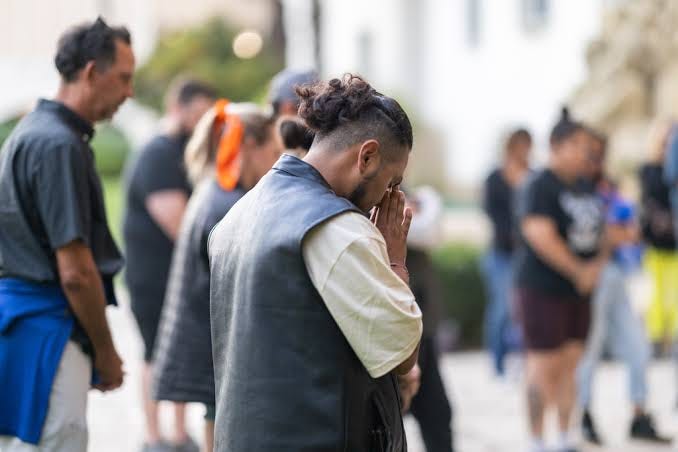
Image: Ingrid Bostrom photo for the Santa Barbara Independent shows the scene at a vigil for Lorenzo Arauio and Johan Guerrero on Monday 13July2026.
Do you have specfics on the deaths? The local police department(s) should have that information. All the rest is rant.