

On Tuesday, Mayor Randy Rowse admonished the lefty majority of Santa Barbara’s City Council to stop using the word “we,” moments before they finally, narrowly passed their beloved ideological project of rent control.
Rowse reminded his four liberal colleagues that he, along with council members Eric Friedman and Mike Jordan, has expressed prolonged and consistent opposition to the massive, complex and costly rent stabilization ordinance, now likely to create an expansive and expensive new bureaucracy at a City Hall already swimming in red ink.
“’We’ aren’t passing it,” he said.
As a policy matter, the mayor’s comments spoke to his belief in the folly of city government imposing itself into the contractual relations between landlords and tenants, warping a large sector of the local economy while damaging the prospects that wished-for new rental housing will be built.
As a political matter, the statement also points to the distortion of popular governance applied by the current structure of the city’s district elections system, adopted a decade ago.
What happened on Tuesday was that a four-member “majority” of council members established a contentious, consequential and divisive new power ministry at City Hall — over the objections of a three-member “minority” who in fact represent a vastly greater number of actual voters.
Fun with numbers. Consider: the four members who passed rent control together won 10,728 votes in their districts the last time they were on the ballot; by contrast, the three members who opposed it won 19,083 — nearly twice as many.
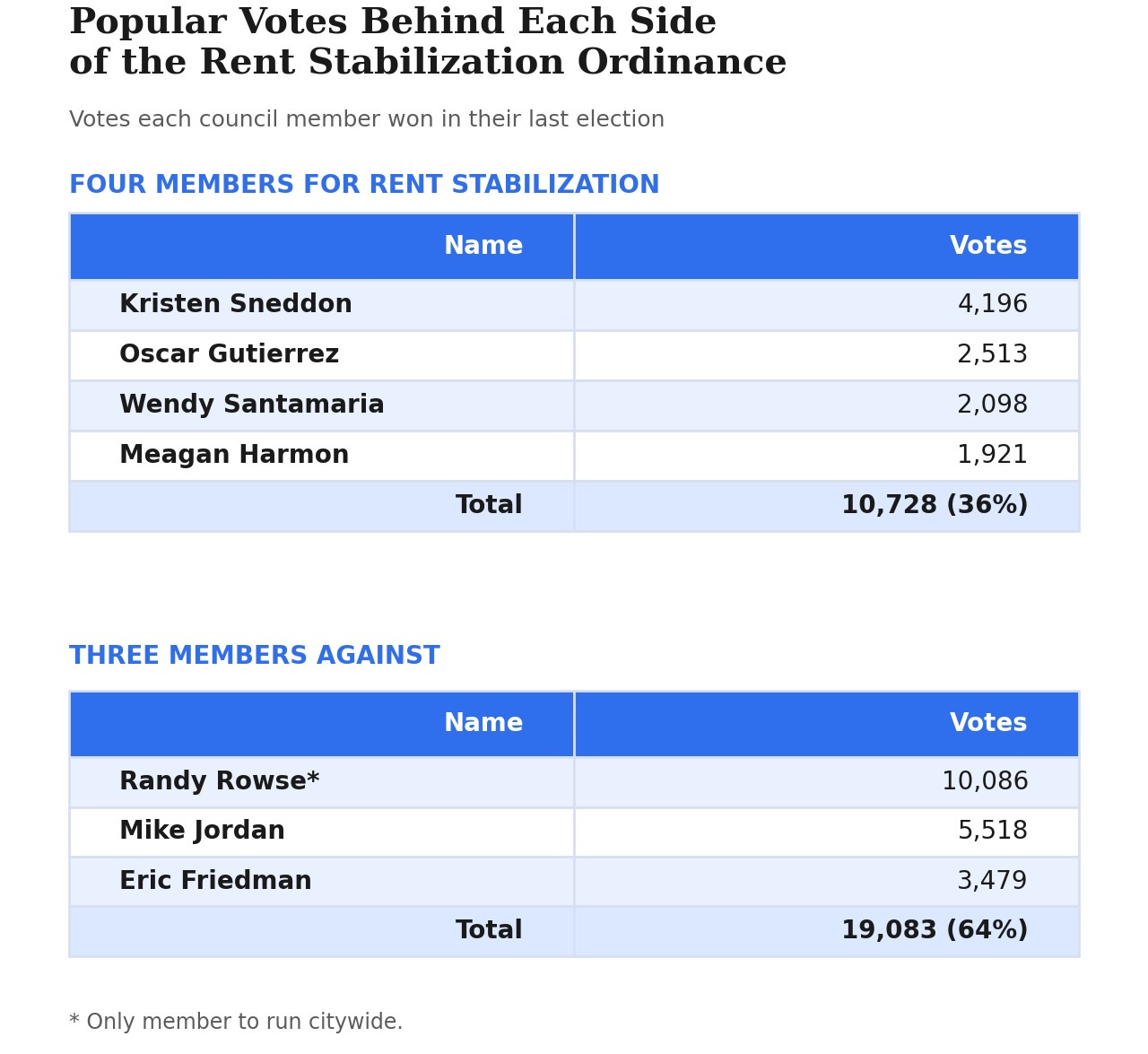
This data point demonstrates the asymmetry between vote share and council power, pointing to flaws in the district system that City Council adopted, under threat of litigation, back in 2015 — and the need for the next council to consider putting some electoral reforms before voters.
For starters: what is the point of having a mayor who runs and wins citywide but then becomes nothing more than one of seven votes on Tuesdays? Possible reforms include giving the mayor — who has the broadest popular support — a veto on 4-to-3 votes, forcing broader consensus with at least a 5-to-2 supermajority; raising the bar for sweeping measures like rent control to require at least 5-to-2 agreement; putting such broad and contentious issues on the ballot for voters to weigh in on; changing the makeup of council to two or three citywide seats and a smaller number of districts; and adopting a system of ranked-choice voting.
There are doubtless many other possibilities for reform, but the bottom line is this: the kind of governance that rammed through rent control is now likely to trigger a new referendum repeal campaign — there’s already one underway for the State Street Master Plan — not to mention a boatload of expensive litigation.
Winners and losers.
Tuesday’s adoption of the rent stabilization ordinance effectively ends one long, slogging saga to pass the measure, and begins another, as City Hall, property owners and renters now become enmeshed in a new muddle of bureaucracy.
“Socializing a private asset is not the road to happiness,” as Rowse put it.
Winner: Wendy Santamaria. Her razor-thin defeat of Alejandra Gutierrez in District 1 two years ago set the stage for the progressive push for rent control, flipping the balance of power in a shift that ended in triumph for one-note Wendy and her singular but very vocal constituency. Sure, she lost a battle with Harmon on Tuesday over exempting Housing Authority units from the same punishing oversight that private landlords are now subject to — but in the end she won the war.
Winner: Meagan Harmon. Triple smart and earnest, Harmon implausibly actually seems to believe the wrongheaded economics behind rent control, and it has been a goal for her since she joined council. In the end, Wendy tried to hog the spotlight, but Santa Barbara cognoscenti know the difference between a workhorse and a show horse. On substance, Meagan did what she mistakenly thinks is the right thing — and on process delivered an embarrassing ninth-inning defeat to Wendy to boot.
Loser: Kristen Sneddon. Conventional wisdom’s front-runner for mayor, Sneddon delivered a Sister Souljah soliloquy designed to distance herself from the polarizing Wendy, shooting hard looks while railing against “how this has played out, and frankly, how I was played.” The problem was that in denouncing Santamaria’s “move the goalposts” determination to adopt the most radical ordinance imaginable, Kristen effectively made the case against the measure she was about to vote for — acknowledging it is far more stringent than what she set out to pass.
Loser: Eric Friedman. With Rowse and Jordan, he predictably lost the policy argument but unnecessarily punted a splendid political opportunity to boost his mayoral campaign. Eric had the chance to make a hard-hitting closing argument that flung the whole divisive rent control mess at the feet of chief rival and rent control champion Sneddon — but instead reverted to form and issued a process polemic, whinging about the “chaos” of the legislative sausage-making, instead of pounding away at the Rent Control Quartet’s bid to defy the laws of arithmetic.
There were no injuries.
Image: memepedia.
report…and thanks for spelling out the mathematical (and chaotic) problem created by the Districts aetup of council.