

(Editor’s note: The stunning victory by Scott Colom in the race for the U.S. Senate in Mississippi is not only the most remarkable event in an astonishing midterm election but also a landmark episode in American history. To better understand the significance of the moment, here, via gift link, is a New York Times piece that looks at the
context of the milestone. —jr).
By Emily Cochrane /The New York Times
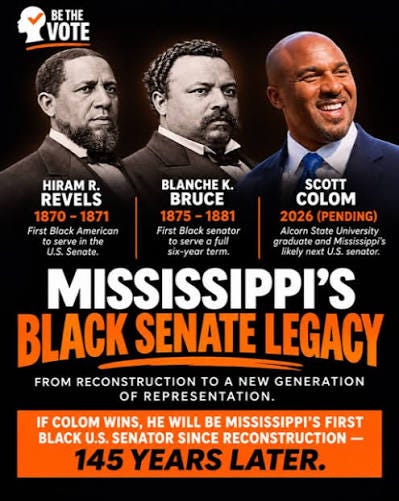
With the race called in his favor on Wednesday, Scott Colom will become the third Black senator in Mississippi history, but the first in nearly 150 years. That legacy traces back to Feb. 25, 1870, when Hiram Revels walked into the chamber of the U.S. Senate to take his oath of office.
The month before, the Fifteenth Amendment had been ratified, giving Black men like Mr. Revels the right to vote in a nation that had been ravaged by the Civil War. Mr. Revels, a man born free in North Carolina who served as a Union Army chaplain in Mississippi, had been chosen by the Mississippi Legislature to be its first new senator after the Civil War.
Two days after the state was readmitted to the union, Mr. Revels became the first Black man ever seated in the Senate. He delivered his first speech on the Senate floor in opposition to an amendment that would stop Black people from holding office.
Black residents, he said, “ask but the rights which are theirs by God’s universal law.”
Mr. Revels was joined soon after in the Senate by Blanche K. Bruce, who was born into slavery in Virginia and fled to freedom at the start of the Civil War. He became the first Black man to serve a full term in the Senate.
Mr. Bruce served from 1875 to 1881, as Reconstruction in Mississippi was in its last, bloody days before white leaders ushered in the repressive Jim Crow era by stripping Black Mississippians of many of their rights. He raised alarms about violence against Black voters, but expressed confidence “in the endurance, capacity and destiny of my people.”
Two Black men — Mike Espy, who went on to serve as agriculture secretary during the Clinton administration, and Representative Bennie Thompson, who won re-election on Nov. 3 — have been elected by Mississippi to the House since Reconstruction.
The Senate had been more elusive. Mr. Revels’s seat would go on to be held by staunch segregationists including James K. Vardaman and James O. Eastland.
In January, it will belong to Mr. Colom.
Emily Cochrane is a national reporter who covers the American South. Subscribe to the New York Times here.
Images: CNN; Instagram