
By Nicole Schneidman and Edison Forman /Protect Democracy
In Minneapolis, ICE officers scanned protesters’ faces at demonstrations, then warned that the protesters were going to be added to a government database.
In St. Paul, an agent photographed a vehicle’s license plate and used that information for intimidation — not just by addressing the legal observer by name, but by driving onto the street where she lives.
In Maine, ICE officers showed up at an observer’s home and warned, “We know you live right here,” after an encounter at an elementary school bus stop.
Their message is clear: We know who you are. We know where you live. We’re watching.
These aren’t isolated incidents. And while they are shocking, they tragically aren’t surprising. These examples are the byproduct of a federal law enforcement agency with dramatically expanded access to surveillance technology acting on behalf of a Trump administration that has decided constitutional rights are threats to be neutralized.
The playbook is familiar to anyone who has studied authoritarian regimes: Identify dissenters, make them visible to the state, and demonstrate that opposition has consequences.
To be clear, the United States has a sordid history of surveilling activists, a history this administration is undeniably building upon. DHS Secretary Kristi Noem has equated those protesting and observing ICE with terrorists, calling the filming of ICE operations a form of anti-ICE violence. Immigration officers are reportedly being directed to gather identifying information on anyone who films them.
But it’s not just the administration’s equating protesters to domestic threats that has led to the scenes we’re witnessing in Minnesota and Maine — it’s ICE’s expanding surveillance arsenal.
Under the Trump administration, ICE has become the most well-funded law enforcement agency in the country, and it’s putting that funding to work to build a data collection apparatus to match.
While ICE’s surveillance capabilities have grown under administrations led by Democrats and Republicans alike, what sets the second Trump presidency apart is its aggressive deployment of technology — supercharged by AI — to suppress constitutionally protected activities.
ICE officers in the field currently have tools to identify protesters, map their associations, and find out where they live — all in real time.
As protesters across the country oppose ICE’s immigration crackdown and documented violence against immigrants and citizens alike, the agency is increasingly demonstrating a willingness to turn these tools against Americans exercising their First Amendment rights.
The function isn’t security. It’s suppression.
But we’re not powerless. ICE’s surveillance apparatus is in part reliant on access to state databases and local partnerships. Around the country, state and local communities are beginning to cut off some of those access points that are ripe for abuse (more on this below).
ICE’s surveillance arsenal. ICE’s toolkit for identifying and intimidating protesters includes a vast array of technologies, many of which remain shrouded in secrecy. But what we do know about how they’re being deployed against protesters is alarming.
Facial recognition technology: ICE officers in Minneapolis reportedly scanned protesters’ faces at the scene where Alex Pretti was killed by federal agents. Observers across the Twin Cities have reported that ICE agents are warning that they’re using “facial recognition” technology and photographing the faces of residents.
Contract records and internal ICE emails reveal the agency is using at least two facial recognition tools. The first is Mobile Fortify, an AI-enabled smartphone app ICE officers are using in the field to verify citizenship status and scan protesters’ faces. The second is Clearview AI, which signed a new contract with. ICE in September to provide access to its massive database of facial images scraped from the internet — in part to investigate “assaults against law. enforcement officers.”
Automated license plate readers (ALPRs): ICE agents eerily driving to the very St. Paul street where a legal observer lives may have been enabled by the weaponization of ALPRs. Companies like Flock Safety and Motorola Solutions operate cameras across the country that can be used to track vehicles’ location histories and identify their owners.
Until recently, federal agencies, including ICE, had access to Flock’s national lookup tool, which aggregates data from thousands of local police departments using the company’s AI-enabled ALPRs. ICE has also begun using a smartphone app called Mobile Companion to scan license plates that’s integrated with Motorola Solutions’ ALPR network. The result: ICE can determine who protesters are, where they live, where they’ve been, and who they associate with.
ICE claims broad authority to deploy these tools, with DHS defining “violence” to encompass making and posting videos of agents in public — activities that ICE might then investigate as “assaults” despite generally being protected by the First Amendment. In a September presidential memorandum, the administration further named “anti-Americanism” and “extremism on migration, race, and gender” as potential motivations animating “violent conduct.” Essentially, any American who observes, protests, or records ICE operations can be subject to AI- powered surveillance.
An expanding panopticon of government data. These surveillance tools all derive their power from data — including sensitive personal data that Americans have already entrusted to their government for entirely different purposes.
ICE has direct access to a range of data that states collect on their residents through the International Justice and Public Safety Network, more commonly known as Nlets, a data-sharing network for law enforcement agencies across the U.S.
When ICE runs license plates through the Nlets system, for example, it can quickly gather sensitive personal information, including residential address, date of birth, physical characteristics, license plate, vehicle registration information, and facial photos (especially helpful for utilizing facial recognition technology).
As reported by 404 Media, Mobile Fortify integrates data from Nlets and several federal databases. And through the ALPRs described above, ICE can access data that is collected by local and state police for routine law enforcement.
This interconnected web of data creates a surveillance ecosystem where a single data point — a license plate, a face in a crowd — can unlock a comprehensive profile of an individual’s identity, location, and associations. And the reality is that government data enables much of (though not exclusively) this capability.
That is why, as we wrote last May, the Trump administration has been on a quest to centralize all forms of data collected by the government.
ICE’s overreaching use of state and local law enforcement data fits the same pattern of systematically leveraging data collected for legitimate government purposes — tax compliance, benefit programs, routine policing — and repurposing it for surveillance and crackdowns without public notice or meaningful oversight.
As the agent of this administration, ICE wants us to believe that surveillance is inescapable. However, the tools that enable federal agents to identify and intimidate Americans engaged in First Amendment-protected activity depend in part on state data and local contracts.
When communities put bottlenecks on the data supply, ICE’s surveillance apparatus weakens. ICE’s power isn’t absolute. It’s borrowed — and we can take our data back.
How to fight back. Just as data provides the fuel for ICE’s advanced surveillance technology, so too does it provide leverage for opposition. From deep blue cities to red state legislatures, public pushback against ICE’s surveillance tactics is growing, and it’s working. The key is to reclaim power over our data.
Local and state governments are taking measures to curtail ICE’s weaponization of their constituents’ data to target and intimidate citizens and immigrants alike.
Over 15 cities across at least 12 states have terminated or otherwise ended their contracts with surveillance giants like Flock Safety, which appears to have misled its customers about DHS’s access to customer data via their “national lookup” tool. Five states have severed ICE’s access to DMV data through Nlets.
Of course, none of these measures alone is a silver bullet. ICE undoubtedly will seek workarounds and loopholes to gain access to some of this data for unconstitutional purposes.
But the reason these measures are powerful is that they provide openings to limit the surveillance machine. While they won’t deter a federal government bent on violating the First Amendment, they do slow and inhibit the weaponization of data against law-abiding citizens, buying time and space to engage in dissent.
Here are three ways you can help curtail ICE’s abusive applications of data and technology:
1. Keep ICE away from DMV data.
Many states provide ICE with unrestricted access to their DMV data through Nlets, allowing ICE agents to gather troves of information on individuals in the field — without a warrant — using only license plates. But some have already moved to change this.
Illinois, New York, Massachusetts, Minnesota, and Washington have already blocked ICE from accessing their DMV data via Nlets. New York has a clear law prohibiting motor vehicle offices from sharing information with ICE for civil immigration enforcement, while Massachusetts’ nondisclosure regulation came from its attorney general’s rulemaking. Minnesota has reportedly stopped sharing all motor vehicle data with ICE (even though its driver privacy law more narrowly restricts certain data sharing, specifically non-REAL ID data), and Oregon is reportedly taking a similar step to ensure its residents’ data is not available to ICE through Nlets without a legislative requirement to do so.
Encourage your state to join their ranks. Contact your state secretary of state’s office, governor’s office, and elected representatives to encourage them to take action to block ICE’s access to your DMV data through Nlets.
Use this email template to send a message in under two minutes.
2. Interrogate local connections to companies like Flock Safety and Motorola Solutions that have a history of sharing ALPR data with ICE.
Local pressure is driving cities to re-evaluate their data-sharing agreements or even terminate their contracts with ALPR companies like Flock Safety. In Flagstaff, Arizona, the City Council unanimously voted to cancel the city’s contract with Flock Safety following extensive outcry and activism from the community. And just last week, 700 people gathered on the plaza in front of Bloomington, Indiana’s city hall to protest the city’s contract with Flock Safety.
Equip your city council members or local sheriff with information on how ALPR data is being used by ICE. Show up to a town meeting, or consider requesting a one-on-one meeting to discuss your town’s ALPR contract.
Download this ALPR advocacy toolkit from the ACLU of Iowa to start a conversation with your city council.
3. Make the invisible visible.
Surveillance thrives in the shadows — and nothing busts shadows quite like a little sunlight. Shedding light on ICE’s surveillance technology and the data it runs on is a vital first step toward building the community power necessary to demand change.
Contact your local newspaper to pitch a story or letter to the editor to expose how your town’s tax dollars may be funding federal surveillance.
Check out the Atlas of Surveillance (a project by the Electronic Frontier Foundation) to see which ALPR technologies are currently deployed in your town. Use this resource to search for your town and select “automated license plate readers” to see results about which ALPR technologies are present in your community. Pair that information with the ACLU of PA’s Guide to writing an LTE to start the conversation.
Nicole Schneidman is Counsel and Technology Policy Strategist for Protect Democracy. Edison Forman is Research Associate for the non-profit. Subscribe to the group’s “If You Can Keep It” newsletter here.
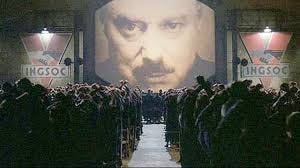
Image: Big Brother portrayed in 1984 adaptation of George Orwell’s “Nineteen Eighty-Four.” (Wikipedia).