

The great political scientist Harvey Mansfield once criticized revisionist historians of the Federalist Papers for failing to observe scholarly first principles.
“It is, I think, a mistake to look under the surface,” he admonished, “until you’ve examined the surface.”
Mansfield’s comment came to mind in recent days, as Newsmakers beheld a stream of downstream discourse that followed our pair of stories, on July 29 and 30, which condemned the display in City Hall of a protest sign festooned with a guillotine.
Our posts not only denounced the sign — which warned City Council of the political consequences of opposing rent control — but also surveyed the reactions of council members to it.
Our reported commentary made two simple points:
When one side in a policy debate feels the need to brandish a picture of a guillotine — an instrument of death that French revolutionaries employed for the systematic execution of many thousands of class enemies - it’s an indication that Santa Barbara’s traditional values of public civility are at risk.
A supermajority of council members believed, but had not stated until we asked them, that the sign was objectionable, offensive and unacceptable in a public hearing, at a time when public officials across the nation increasingly are the targets of intimidation, threats and, sometimes, violence.
Which seemed straightforward enough.
It’s a sign of the times, however, that even something as seemingly innocuous as criticism of a guillotine sparked an uproar, with partisans on both sides of the political divide wielding the Newsmakers posts as a cudgel on behalf of their team in the culture wars.
Two simple pieces of local accountability journalism got stripped for parts by writers and outlets with political priors, and spun off into self-interested narratives — without the bother to examine what Mansfield might call the “surface” of our actual reporting.
Three takeaways:
60 heads a day. Six days after our first piece, esteemed journalist and liberal political donor Eileen White Read took to Edhat with a truculent denunciation of Newsmakers’ denunciation of the sign.
At one point in her piece, she described the guillotine sign as “a metaphor for poor people’s desire for revolutionary change.”
That’s one way of putting it.
For those with fuzzy memories of high school world history, however, the guillotine also equates with the Reign of Terror — that period of the French Revolution between September 1793 and July 1794 when it was employed to behead about 17,000 people, roughly 60 a day.
“Let’s make terror the order of the day,” revolutionary leader Bertrand Barère famously declared to kick off the guillotine era, while Maximilien Robespierre cheered on the beheadings, declaring terror “less a principle in itself than a consequence of the general principle of democracy.”
Despite the facts of history, Read could not abide the suggestion that the rent control crowd might want to find a better “metaphor” for their views.
At 1,072 words, her attack on Newsmakers — “Journalists Shouldn’t Be Accusing Tenants Rights Advocates of Supporting Murder” — was one-third straw man argument, one-third insinuation of journalistic malpractice and one-third Thought Police rant, implicitly questioning our right to publish the piece at all.
In the process, she not only provided media cover for political proteges, but also erected a permission structure for the kind of public browbeating Newsmakers called out in the first place.
It’s noteworthy that Read is a financial and political patron of both Wendy Santamaria and Kristen Sneddon, the chief sponsors of rent control on council. (Campaign finance records show that her $5,900 donation to Sneddon is to date the single largest contribution to the council member’s mayoral campaign, and that Read also has given at least $11,000 to Santamaria, whose activist allies shaped the tone and tactics of the boisterous public hearing at which the offensive sign was wielded).
To her credit, Read slipped a parenthetical disclosure into her op-ed acknowledging that she backs Sneddon in the mayor’s race.
“I live in District 4 and I support my council member’s candidacy for mayor,” she wrote, with admirable understatement.
Like Read, we also live in District 4. Unlike her, we don’t donate to politicians, or glaze them with hagiography, like this.
Whitewashing Trump. High-end realtor Brian Campbell offered a different critique of Newsmakers’ guillotine commentary from the other side of the political spectrum, on Aug. 6, in the local pro-Trump organ SB Current.
Without crediting Newsmakers’ reporting, he inveighed against the guillotine sign, lamenting it as a symptom of “rhetoric (that) dehumanizes people and has become part of our national political vocabulary.”
Excuse us while we build a stadium large enough to hold our laughter.
Newsmakers is old enough to remember the pandemic, when serial failed political candidate Campbell joined the parade of disruptive public commenters at Santa Barbara Unified School District meetings, where they routinely targeted trustees, administrators and teachers with insults and disrespect over masks, school closures, vaccines and other public health precautions.
In his guillotine piece, Campbell took issue with an argument we had made, drawing a direct connection between public provocations at City Hall and Trump’s befouling of public discourse. “That struck me as remarkable,” he scolded. “Trump wasn’t at the meeting. He has no authority over Santa Barbara’s rent stabilization ordinance.”
To his Covid-era amnesia, Campbell thus adds a bout of willful blindness with regard to his Dear Leader’s decade of non-stop lies, personal insults, crude language, violent imagery, encouragement of violence by supporters, weaponization of conspiracies and inflammation of every racial, gender, and cultural fault line in American politics.
Elsewhere on the radical right, Rupert Murdoch’s California Post also seized on the guillotine sign controversy, in furtherance of its start-up editorial mission of building a Southern California audience via right-wing grievance-mongering.
The Post lifted our first piece from Edhat, which had republished (with permission) our posting on SB Newsmakers, our Substack newsletter platform. The Murdoch publication on Aug. 2 characteristically sensationalized it with a scare headline: “Santa Barbara erupts over terrifying guillotine sign displayed at City Hall.”
Predictably, the Post also failed to pick up the second-day story, which expanded and filled out our original reporting.
Bully pulpits. Amid polarized pushback, it’s tempting to lower ourselves into a warm bath of self-congratulation while softly murmuring that ancient journalistic trope, “We must be doing something right — both sides are mad at us.”
But this ain’t that.
It’s the job of the local press to hold elected officials accountable for their words and actions; that journalistic responsibility also extends to political actors across the spectrum, whether it’s anti-vaxxers on the right or rent control activists on the left.
What’s notable about the partisan reaction to Newsmakers’ columns is the knee-jerk move by both sides to retreat into self-serving argument — without so much as a nod to, let alone engagement with, the actual news in our reporting: the troubled reactions to the guillotine sign by a supermajority of city council members, when they were finally asked how they felt about it.
And it’s a damn shame that local public officials are now routinely bullied, menaced and subjected to performative intimidation at public hearings in nearly every government venue.
Somehow in Santa Barbara, those who disagree have come to be seen as bitter enemies — not neighbors with a differing view.
As council member Eric Friedman told us, in a comment that echoed similar sentiments from several colleagues, “In a time when elected officials have faced threats, violence and even been killed, everyone should take time to think about the potential ramifications of their actions.”
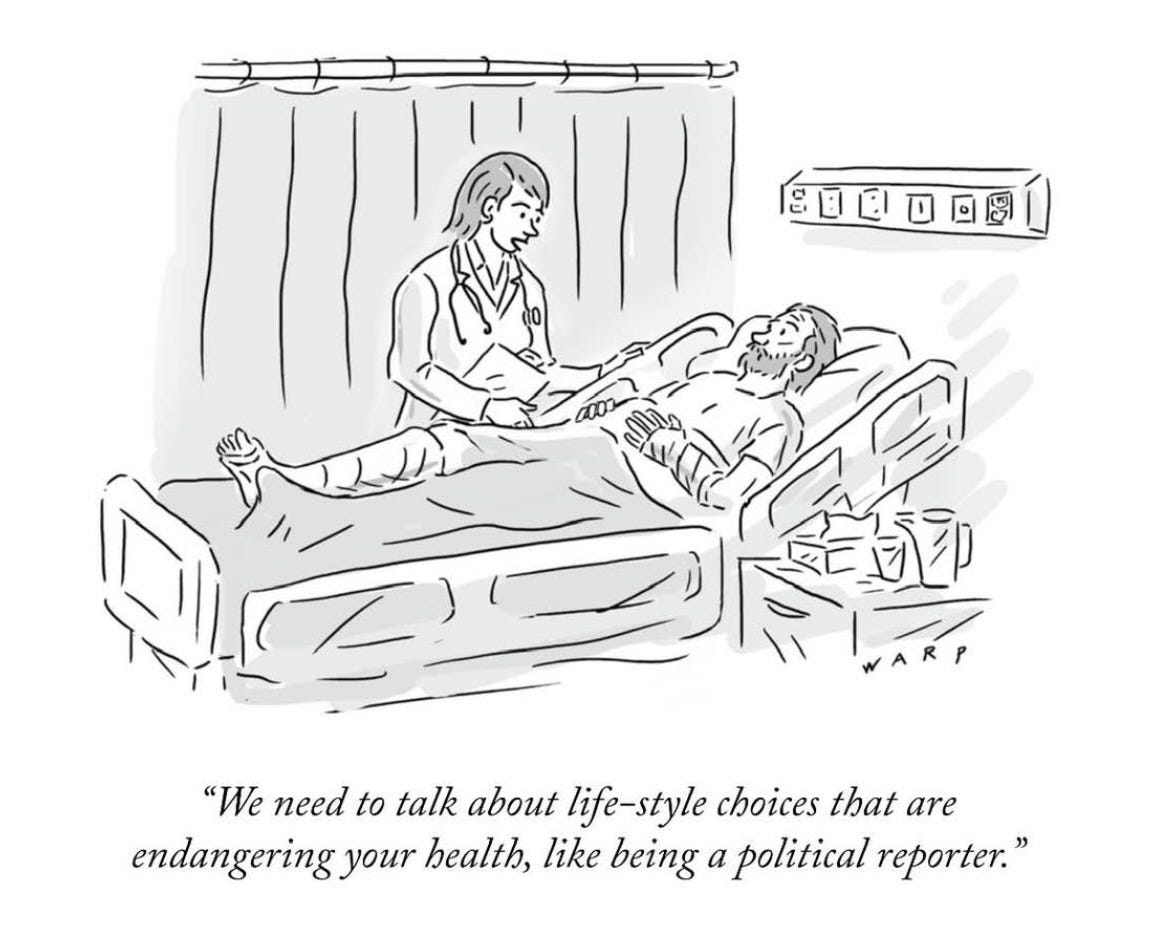
Image: Kim Warp cartoon for The New Yorker.
Excellent point, and brilliant defense of journalistic principles.
Jerry, I have too much respect for you to get into a pixxing contest. The Jerry Roberts I respect would have simply admitted to making some errors: Yes, in my haste, I neglected to get comment from a young lady who was the subject of a highly negative news story, opening not just myself but the publication that printed my piece to legitimate criticism and possible threat of litigation. Yes, I shouldn't be writing news stories about subjects, such as rent control or stabilization, in which my personal biases and preference for certain politicians is well known; when I cover politics, it should be properly labelled as an op-ed or commentary. Yes, my personal attack on Councilmember Kristen Sneddon went too far.