
By Suzanne Cohen
The bill came due here: Santa Barbara became the cannabis capital of California, and all of us are now left paying the costs.
Twenty years ago, Santa Barbara County was known for avocados, wine, and the price of a house on the Riviera. Nobody was driving out to Carpinteria to smell a greenhouse. Nobody had a neighbor running an air scrubber through the night.
Then the state legalized it, and the county had to write rules for an industry that had never been legal. Many of us said go slow. Slow was not the plan. What happened instead is that politicians who were being lobbied, effectively and relentlessly, were convinced that this county should be the one to figure it out first, and they moved. A lot of us were opposed to that expansion. We lost that fight. Not because we were wrong, and not because we were in the minority in our own neighborhoods, but because we were not the ones in the room when the decisions got made.
It worked, if that’s the word. Santa Barbara County now grows more cannabis than anywhere else in California. Growers reported more than fourteen million pounds in 2025, a third of the state’s harvest, worth about four hundred million dollars, up nearly twenty-eight percent in one year. That is a real economy and I won’t pretend otherwise. What I won’t do is pretend the rest of us came out ahead. Because the sales are private and the bills are public, and the bills are still coming in.
They built the business faster than they built the rules, and the people who paid for that gap were the ones living next door. Roughly four thousand odor complaints have come through the county since 2018. Not four hundred. Four thousand.
Then came the lawsuit. In March of 2025 a judge in Santa Barbara certified the first cannabis odor nuisance class action in the history of California, against a greenhouse operation in the Carpinteria Valley. Every homeowner within a mile was certified as part of it. In a state where this industry has operated for years, in county after county, nobody had ever gotten that far. It happened here, triggered by our neighbors’ complaint. That is what it takes to make a judge do something no judge in California has ever done. It is the sound of a place catching up to a decision it made too quickly.
Potent candy and the vulnerable. And it is not only the smell.
The California State Auditor opened forty cannabis retail products and found that twenty-three of them, nearly three in five, were packaged to appeal to children.
That is not an activist’s claim. That is the state of California, in its own audit, describing what we allowed onto the shelves. A product being sold to adults, deliberately dressed up to look like candy to a kid. And the product itself is climbing in potency, far past what anyone called marijuana when the county was writing the rules. The addiction numbers that come with that concentration are frightening, and the ones who get hooked are often kids, before they have the judgment to say no.
Marketed as part of a ‘healthy lifestyle’ by paid influencers. The industry’s growth plan has always included the young, because that is how an industry builds a permanent customer base. When we ask politicians to protect the people who cannot protect themselves, we get assurances, we get language about responsible approaches, and then we get another storefront.
There is no trust here. Not from those of us who know this industry. There is just talk. And if you want to know why there is no trust, look at who was representing this industry to your elected officials. Not a farmer. Not a business owner down the street.
Public affairs professionals whose job was to make all of this look inevitable, and reasonable, and good for us. You can read the interviews yourself, as they talk about how fascinating the expansion was, how proud they were of it. That is the voice that was selling this to the county, and it is the same voice now asking for your vote.
The rules got made by people with no stake in whether the vulnerable were protected. The profits are privatized. The costs are socialized.
A personal note. And this is where I have to say something I haven’t wanted to write.
Some people spent years on that fight, and it cost us. It tore apart friendships people thought were permanent. It split organizations. That is what happened. There are people who will not have dinner with each other again because of what got done to people who needed to get out of the way.
I don’t say that for sympathy. I say it so you understand the stakes, and so you know that when I tell you there is no trust here, I am not speaking from a pamphlet.
For those tied to this industry and asking for our vote, I want the record. What you did, what you advocated for, and who was helped or hurt by it. The state’s audit is the state talking. The class action is a judge talking. The complaints are our neighbors talking.The only ones still telling us it’s all fine are the ones who were paid to say so.
I know how this sounds, and that some of you will read this and decide I’m fighting a fight that is already over.
It is not over. It is just quieter now, and it is happening at the ballot box.
Suzanne Cohen, a past president of STESA, formerly the Santa Barbara Rape Crisis Center, served four years as president of a countywide Democratic women’s organization. A District 4 resident, she is on the city’s Harbor Commission.
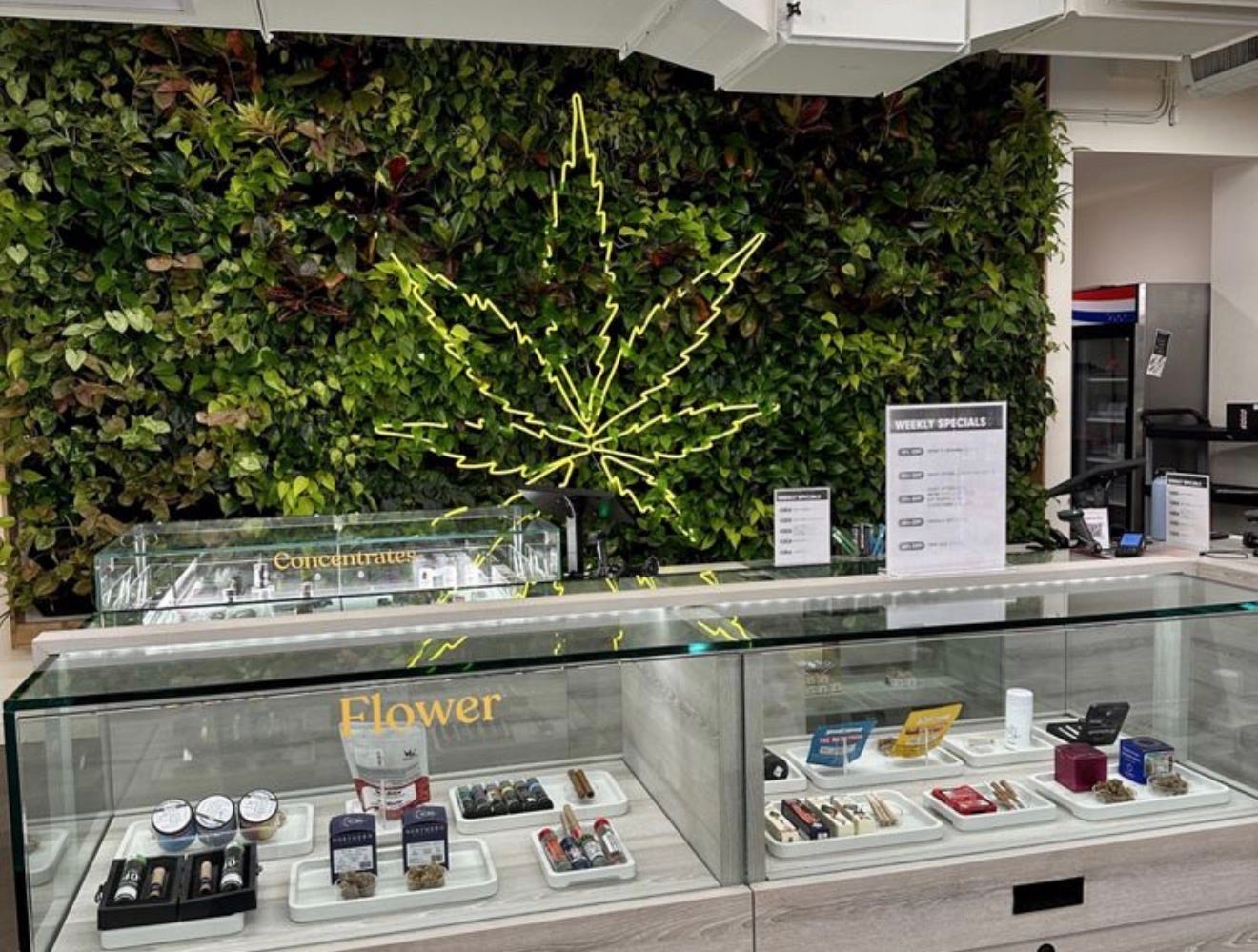
Image: Interior of cannabis dispensary (Yelp).
Nice to see there is common ground here. With conservatives and a few democrats.
We should mention for the record that pot is still somewhat illegal, if the Feds ever decide to shut it down. And there is the matter of young people that are addicted to pot, and other longer term effects.
What, exactly is on the ballot? I’m confused about downstream impacts that are not really discussed but are in the headline. I am one of those who spoke out early and often. I even helped draft an ordinance that would have addressed the odor, but the Supervisors (plural) wouldn’t consider it. I represented a property owner who was concerned about a cannabis store on Santa Claus lane who was motivated by his concern about having this available at that location. I am now paying a huge price, personally for publicly criticizing the cast of characters that “enabled” this mess, so I empathize with the author, who I don’t know. While I assume she is more tactful than I, I would not recommend she stay in this fight, lest her “best” friends turn on her.