

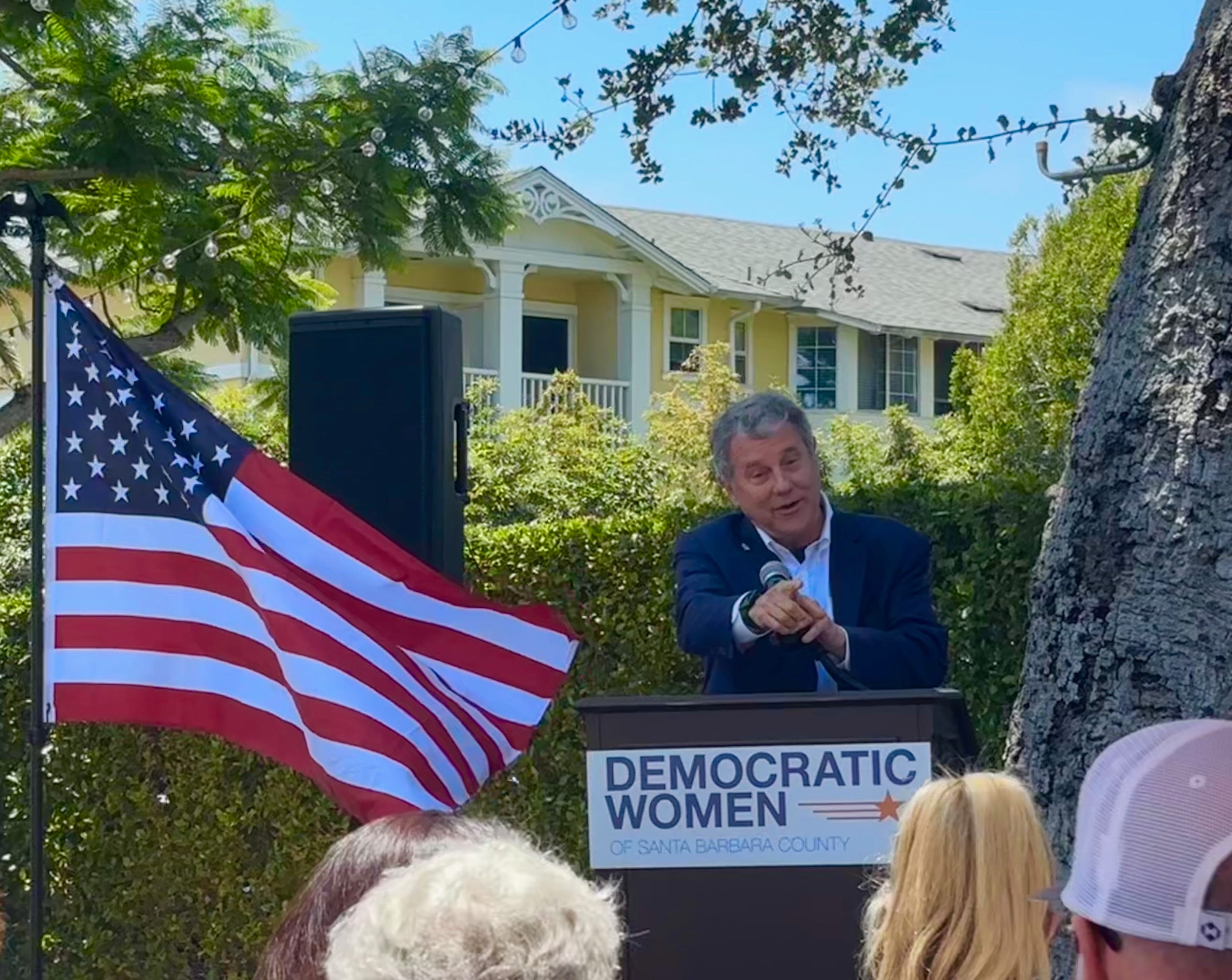
Ohio U.S. Senate candidate Sherrod Brown brought his insurgent campaign to Santa Barbara on Sunday, telling friendly Democratic audiences that conditions are ripe for a wave election that tosses “enablers” of Donald Trump out of Congress.
At a Democratic Women’s Club Flag Day luncheon at the Santa Barbara Club, and at a Hope Ranch fundraiser later, Brown voiced the themes of economic populism and political optimism that shape his challenge to appointed Republican incumbent Jon Husted in Ohio, where the race is rated a toss-up.
Brown, who lost his Senate seat in the Democratic wipeout of 2024, is among the contenders in a handful of crucial states for whom the party has hopes in the Nov. 3 midterm election of netting the four seats needed to flip control of the Senate, while remaining currently favored to win back the House of Representatives.
“What we see in 2026,” Brown said at the Democratic Women’s event, “we see a bad economy that is rigged — an economy rigged against workers, against the middle class, against people struggling, against poor people.
“We see an economy that’s rigged,” he added. “We see a very, very unpopular war and we see a crooked president.”
A blue-collar voice. Before losing his 2024 re-election bid by three points — as Trump carried red state Ohio by 12 points — Brown was seen as one of his party’s best envoys to blue-collar, working-class and rural voters, traditional Democratic constituencies that have decamped in huge numbers for the Republican Party over the last decade, drawn by Trump’s economic populist promises and unbridled anti-elitist rhetoric.
Instead, Brown said, Trump in office has pursued policies — from tariffs to the unpopular Iran war — that have worsened economic conditions for working people while benefiting his own family, cronies and a small number of super-rich supporters.
“We watched the first day — at Trump’s inaugural — when the billionaires stepped down from their limousines, walking into a building that to me is a sacred space, in many ways for our country, and walked into that building, walking up to the stage like they owned the place,” he said.
“And it’s pretty clear, from day one, from January 20th at noon on, that they did own the place,” he added.
Brown said that when he talks to rural voters in Ohio, who went overwhelmingly for Trump in 2024, large numbers are unhappy with the impact on their export sales of the administration’s tariffs and trade wars; many also are suffering from spiking prices of fertilizer and diesel fuel during the Iran war. Yet many of these voters still do not blame Trump personally for their woes, he said.
“So I’m not running against Trump, nor are (other Democratic Senate candidates),” Brown said. “(We’re) running against people that have enabled all of this to happen to rural Alaska, rural Texas, rural Ohio — they’re fighting back … and those voters are going to hear that.”
Assailing congressional Republicans as “spineless sycophants,” the Ohio Democrat said that “many of these members of the Senate, many of them know better.”
“Some of them laugh at Trump behind his back,” he said. “All of them supposedly love this country. All of them took an oath of office and they simply abandoned that.”
Democratic despair. Brown said he recognizes that many Democrats despair at Trump’s relentless and ruthless attacks on cherished programs, norms and values, but he remains optimistic because of his own political experience.
First elected in the blue wave election of 2006 — when Democrats won control of the House for the first time since 1994 and took effective control of the Senate by picking up six seats, at a time when embattled Republican President George W. Bush was broadly unpopular amid the Iraq War — the candidate said there are many parallels to that political landscape this year.
“It was 2006 … people were unhappy with the war,” he said. “They were unhappy with a corrupt president. And they were unhappy with where the economy looked to be going.”
Image: Sherrod Brown speaks to Dem Women at Santa Barbara Club (Josh Molina photo).