
(Editor’s note: The June 9 killing of Lorenzo Salgado Araujo by ICE agents in Houston was the 10th fatal shooting by federal immigration authorities in less than two years of the second Trump Administration. As in previous cases, the government immediately set forth a false narrative blaming the victim for his own death. As The Bulwark’s immigration reporter Adrian Carrasquillo shows, it’s becoming an all-too-familiar and cynical practice. -jr)
By Adrian Carrasquillo /The Bulwark
There is a familiar pattern to how the Trump administration responds when its immigration enforcement agents commit a high-profile killing: They move swiftly to malign the victim.
Usually, this involves dredging up menacing pictures. Often it means pointing to past, unrelated crimes. In the case of Alex Pretti, it meant surfacing video of a separate confrontation he had with ICE officers before he was fatally shot.
Now, following the killing last week of Lorenzo Salgado Araujo by ICE, we find ourselves in this cycle once again.
Reports emerged on Wednesday that the FBI, which is leading an investigation of the confrontation in which Araujo was shot to death in Houston, claimed to have found potential “controlled substances” in Araujo’s van.
According to a search-warrant application approved by a judge on Tuesday and obtained by the New York Times, an FBI special agent inspecting the van sometime after the fatal incident saw eight “plastic bags with what appeared to be a white crystal-like substance”—packaging supposedly “consistent with methamphetamine.” The news was quickly amplified by right-wing media, which posted photos from the warrant application showing the small bags of powder.
Alarm bells went off immediately.
It’s unusual for an application like this to be unsealed so swiftly, as the Times notes. And knowing the Trump administration’s history of vilifying its victims, it was hard to escape the suspicion this was orchestrated to insinuate Araujo was not an innocent working-class immigrant father but rather a . . . drug addict? A drug pusher? A bad guy somehow deserving of the bullets?
It strained credulity. And, sure enough, a day after the Times report, local officials poured water on the claim. “Based on the information we have regarding who Mr. Salgado was and just eyeballing the evidence as it was collected yesterday, we don’t believe that they are drugs,” Harris County District Attorney Sean Teare told CNN. He added, “We have information that we’re not going to release yet.”
While Teare wasn’t ready to release the information, the lawyer for Lorenzo’s brother Victor felt no such compunction.
“After consulting with my client and his family, our understanding is that this was granulated salt, which is paired with lemon and water as a homemade electrolyte mix used by outdoor workers in extreme Texas heat, not methamphetamine or any other illicit substance,” that lawyer, Ruby Powers, told the Texas Tribune.
Regardless of the origin of the substance in the van, there is something deeply unsettling going on here. It’s not just that law enforcement seems more intent on winning PR campaigns than holding bad actors to account; it’s that they’re smearing people even after they’ve shipped them off to their graves. If, indeed, the substance in his car was a homemade mix, that would add another layer of insult: Lorenzo being defamed for preparing a drink to help him do his backbreaking work.
The documented evidence on Lorenzo depicts a good man. A hard-working father who put three kids through college. He was not the target of ICE operations the day he was killed. Nor, as the Times notes, were drugs “the reason for the encounter” that resulted in his shooting. In fact, the paper notes, “there has been no indication that agents pursuing the van that day suspected drugs were present.” Nor have there been indications that Araujo or his passengers were involved in criminal activities.
Given the groundswell of outrage—which was compounded by the killing of another Latino father, Johan Sebastián Guerrero, in Maine six days later—it’s hard to look at these claims as anything other than an attempt to concoct a post-hoc pretext for Araujo’s murder.
It is a hamfisted attempt to absolve ICE. And it comes as there are some really important questions about the killing that still need to be answered.
A gap in the official timeline. Lorenzo’s sons are understandably taking a reprieve from press engagement to prepare for the funeral, but a person who spoke with them told me they are concerned about an apparent gap in the official timeline—an unaccounted-for period between the shooting and when their father was taken to the hospital—which raised further concerns about why the FBI was now claiming there were drugs in the van.
“DHS published their dad’s identity before Ronaldo even knew he was dead,” the person outside the family who spoke in depth to the brothers told me. “He didn’t know his dad was dead until 3 p.m. But Lorenzo didn’t get to the hospital until noon. Where was he between 7:30 a.m. and noon?”
There are also questions about what medical attention Lorenzo received at the scene, if any. Rep. Sylvia Garcia (D-Texas) told me that, according to the men present in the car with him, Lorenzo’s care was limited to “a rag or cloth on him where he was bleeding” after “they held Lorenzo on the ground with a knee to his body as he was bleeding.”
There was no first aid administered, the congresswoman said.
The person who spoke to his sons made this point as well. “What’s not getting the attention it deserves is the lack of first aid medical attention for Lorenzo. . . . There is this suspicion ICE agents were getting their story straight before they reached out to anybody else.”
Domingo Garcia, president of LULAC Adelante PAC and former head of the League of United Latin American Citizens, a significant Hispanic civil rights organization working with the Araujo family, also expressed concern about ICE’s vague timeline.
“He gets shot around 6 a.m. He’s on the floor handcuffed and crying for help in pain and he’s not getting first aid,” Garcia told me. “What we heard from his brother Victor was the ICE agents were mocking him, saying ‘You tried to escape, now look at you, what can you do?’”
Domingo Garcia also reiterated LULAC leadership’s statements from last week, based on conversations with Lorenzo’s son Ronaldo, that the delay in identifying Lorenzo was due to ICE taking his wallet from his pocket, leading him to be classified as a John Doe at the hospital.
“Why would they do that? That creates a motive of trying to hide the identity of who has been shot so the family will not know and will not be able to investigate,” Garcia said. “Ronaldo went to the site several hours after his father had been shot. That’s when he talked to an FBI agent who later texted him ‘Your father has been taken to Ben Taub [hospital].’ He goes there, but there is no one by [his father’s] name. He winds up calling Congresswoman Sylvia Garcia, and later finds out his dad has already passed away.”
A positive step. After reports that the three men in Lorenzo’s van, including his brother Victor, were refusing to self-deport and sign waivers of deportation despite being pressured to do so, there was a hopeful development this Wednesday.
Both Harris County District Attorney Sean Teare and lawyers for the three men who witnessed the shooting said all three had their requests for “U” visas certified. The U visa is designated for victims of crimes who may be “helpful to law enforcement or government officials.”
This does not mean they have received the visas; it means they have just completed the necessary first step in a two-step process: receiving certification from a law enforcement agency—in this case, Teare’s office—that the applicant could be useful in an investigation.
The second stage requires approval from United States Citizenship and Immigration Services and can take years. But the certification should be enough to keep the men in the country. While waiting, the men should be eligible for work authorization, and if their visas are approved and they stay on the visa for three years, they should be able to apply for green cards. Regardless, after what they’ve been through, it is a significant protection against deportation.
Immigration journalist Adrian Carrasquillo writes the “Huddled Masses” newsletter for The Bulwark. Subscribe here.
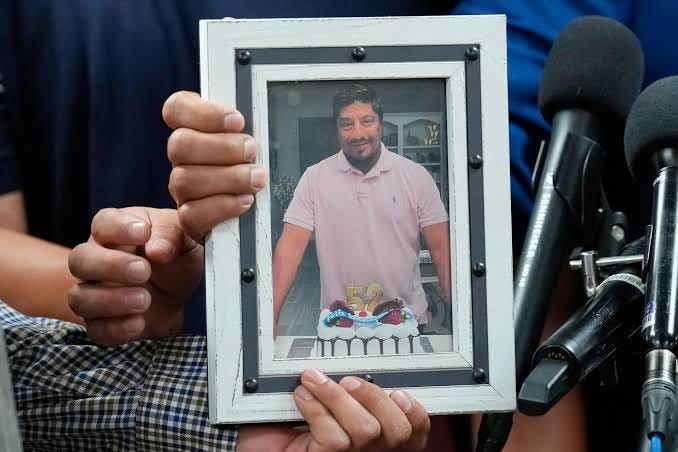
Image: The sons of Lorenzo Salgado Araujo hold a photo of their father celebrating his 52nd birthday (Time).