
By Jonathan V. Last /The Bulwark
Once Iran demonstrated the ability to control the Strait of Hormuz in the face of American force, the end state of this war was determined.
At some point, America would give Iran a bunch of concessions in exchange for Iran allowing transit of the strait. Those concessions were always going to be some version of the following:
An end to U.S.-led sanctions against Iran.
Cash payments of some sort to Iran.
An “agreement” which, whatever it said, did not practically bind Iran on future pursuit of nuclear materials.
Iranian de facto management of the strait, irrespective of international law.
That was always going to be the eventual deal. The only question was the timing. How much pain would Trump be willing to absorb before he surrendered?
Now look at the situation from Trump’s perspective.
If that was always going to be the deal, then what could Trump get out of it? What sweetener could be added to make him bite the bullet?
The sweetener was never going to be substantive—the contours of Trump’s surrender were immutable. His sweetener would have to be cosmetic. The Iranians would have to give him something to get him to “yes.”
They realized that they could afford to give him optics.
Trump thinks of everything in terms of television. Why was announcing a “deal” on Sunday, June 14 more attractive than doing it on Wednesday, June 3?
Because he had a captive audience on June 14 assembled to sell his story about a glorious blood sport in celebration of America/his birthday.2 For Trump, the TV version of this story was a good one:
He breaks the news of his “deal” shortly before the cage fighting begins.
The event becomes a victory rally.
The story of the “deal” is then intertwined with Trump’s celebration.
The upcoming Freedom250 festivities are then used as a clear point of demarcation from which Trump turns the page on Iran, leaves the war behind, and moves on to the midterm elections with a clean slate.
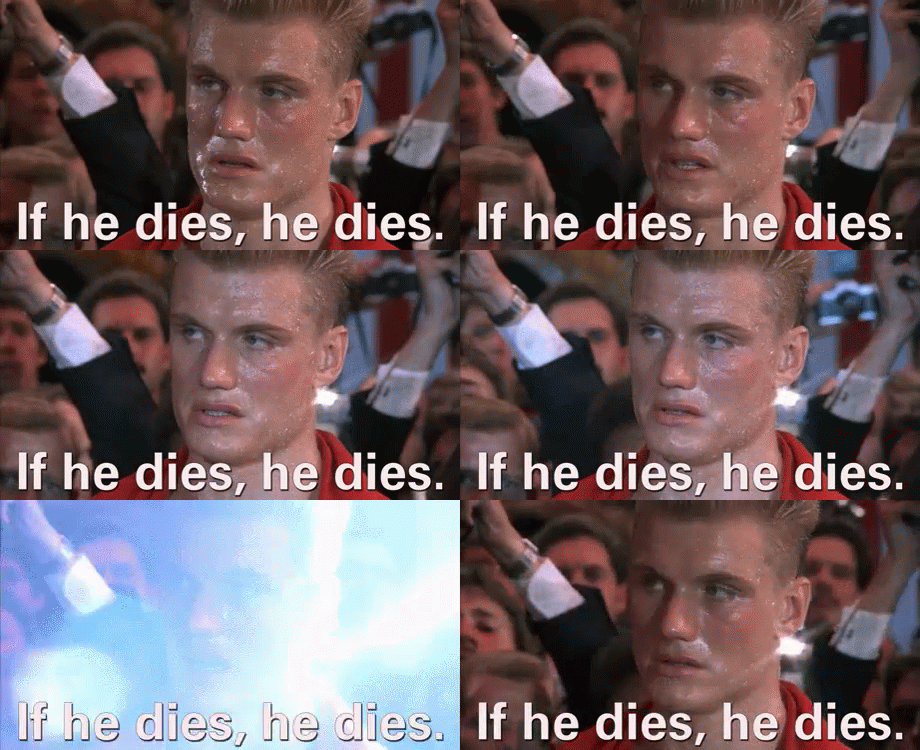
I promise you that in his lizard brain, Trump envisioned the “deal”/cage fight playing out like Apollo Creed’s entrance in Rocky IV: a huge, celebratory American spectacle.
And no. I don’t think Trump remembers what happened after Apollo came prancing to the ring in his Uncle Sam hat.
So that’s why I thought there was a good chance Trump would get a “deal” yesterday. The terms were never in doubt. The Iranians would get everything they wanted. But Trump had to get something to impel him to make the deal; packaging the announcement with his long-planned UFC event was a freebie for Iran.
What is the Deal? The next key was understanding that any “deal” Trump announced would not actually be a deal. It would be a memorandum of understanding, which punted all important questions into the future. This MoU would serve dual functions.
For Trump, it allows him to claim the war is over and get out of the theater.
For Iran, it allows them greater control over the next phase of negotiations, which will determine how those conditions up top 👆 are put into practice.
From Trump’s perspective, he needs two things:
To get out of the war and make Iran someone else’s problem.
To insulate himself politically from the effects of his surrender.
What this means practically is that Trump needs to be able to claim that:
The strait is open and there are no “tolls.”
He, Donald Trump, did not give Iran cash.
Iran will “never” pursue nuclear weapons again.
These are the specifics that will be negotiated in the next phase and I can tell you right now how each of them will go.
Tolls. Iran will pledge not to charge “tolls” on shipping through the strait. However, they will create a new body to administer the sea lane in the name of safety. Probably they will present this as a partnership with Oman. This new administrative body will, of course, need to charge some nominal fees to ships transiting the strait.
You know, to cover safety and management costs. Maybe to fund environmental protections.
But make no mistake, these fees will not be “tolls.” 🙄
America’s tacit acceptance of this new management structure will mean the destruction of the regime of international laws which governed the strait prior to America and Israel attacking Iran.
Cash. Trump has long criticized Barack Obama for releasing $1.7 billion in frozen Iranian funds as part of the JCPOA. In order to satisfy his base, Trump needs a way to claim that he, Donald Trump, did not provide any cash to Iran.
But the Iranians are going to demand hard currency as part of America’s surrender. So Trump will want the surrender payments to come from other Middle Eastern countries. Like UAE.3
And if America has to find a way to give aid to Gulf States in the name of repairing critical infrastructure damaged during the war? Well, dollars are fungible. You work it out.
Nukes. The MoU will probably stipulate that the nuclear portion of the negotiations will be worked out . . . at some point in the future.
And maybe it will. Or maybe it won’t.
Why would it not get worked out? Because once Trump leaves this war, he ain’t never getting back in. The Iranians had a lot of leverage on Saturday. Now that this “deal” has been executed and Trump has declared victory, their leverage increases. Because for Trump to continue to sell the deal as a victory and not a surrender, he can’t take any actions that would suggest that the Iranians aren’t cooperating.
Whatever happens, the broad contours of the nuclear deal will be something like:
Both sides agree to work it out in the medium-term future.
At some point, Iran super-duper double promises not to seek nuclear weapons.
This promise will be tied to a consequence which is impractical to enforce.
Iran will wait to continue nuclear progress for a couple years while they spend efforts restocking their drone and air-defense capabilities.
So long as Iran doesn’t test a nuclear weapon before 2029, Trump will be happy. And the Iranians now know that as long as they control the strait, they are basically free to continue progress on their nuclear program so long as they don’t rub Trump’s nose in it. He just needs plausible deniability.
Bottom line. We should be explicit and clear-eyed about what this all means: America lost the war.
America began this war as either a partner or client of Israel. We began with war aims that were unclear, but which variously included regime change, unconditional surrender, the destruction of Iran’s missile capabilities, and a permanent end to Iranian nuclear ambitions.
We will exit the war with none of those goals achieved, and in order to end the war, America had to submit to a host of Iranian conditions. We lost and there is no reasonable way to hide this fact.
So what did it cost us?
Truth and consequences. Here is a rundown of (some of) the consequences of Trump’s defeat.
Iran is now a mid-major power. Before the war, Iran was a pariah state ruled by an aging mullah while fending off massive internal unrest. Post-war, Iran has made a successful transition of power; will have forced the world to stop sanctioning it; will have defeated a regime of international laws and annexed control of one of the world’s most important waterways.
No longer a pariah, Iran is now in the position to force its regional neighbors to make peace with it and learn how to live with the Islamic Republic.
China’s right hand. Have you ever wondered why the Chinese courted the Iranian regime? The ChiComs have no ideological kinship with the theocrats in Tehran. But the Chinese are dependent on the flow of oil east from the Gulf and they understood that Iran might one day control that flow. So they created a working relationship.
Now that Iran controls the Strait of Hormuz, China also controls the Strait of Hormuz. Which strengthens China’s hand in dealing with wary neighbors such as South Korea, Japan, and even Australia. Not to mention Taiwan.
China’s pre-existing relationship with Iran is now an extremely valuable source of power undergirding the Chinese ambition to dominate its near-abroad.
End of the unipolar American order. There are lots of ways America influenced the world order it created following World War II. The biggest was by guaranteeing freedom of navigation. We built a bunch of institutions that benefited basically everyone (but mostly us) and took over from the British as the enforcers of freedom of navigation.
The Strait of Hormuz was governed by international laws enforced by American hard power up until 100 days ago.
Now the strait belongs to Iran. International law has been replaced. We have acceded to this change. We have proven that America no longer has the strength, will, or wisdom to enforce free navigation.
From this, everything will change.
The unipolar world will be replaced by multipolarity. If America does not control everything, then different powers will control different areas. Iran will dominate the strait. The Chinese will dominate the South China Sea. Every set of interests will have to make separate arrangements with each regional power. The Europeans will have to deal with Iran and China—and America—separately. So will the Gulf states. So will the Asian countries. And India.
First, this new order will be inherently unstable. Too many moving parts dependent on too many brittle, authoritarian regimes, with too many overlapping claimed spheres of influence.
Second, America’s relative position weakens. The fact that countries also have to placate the Iranians and the Chinese means, by definition, that our relative importance declines. Meaning that we have less leverage. Meaning that our ability to protect our interests diminishes.
America will have to content itself with bullying South America and the Caribbean nations—and seeing if we can bully the Europeans into ceding Greenland.
Fortunately, that arrangement dovetails nicely with Trump’s ambition for America. He never cared about preserving the American order. He wants to use America to further his own interests—and he can do that more aggressively if international law breaks down and he is liberated to throw America’s weight around in our hemisphere.
Cuba is next and I would not be surprised if we return to stalking Greenland.
The Israeli–American crackup. Over the last two years the government of Israel systematically destroyed its standing in the world. In America, the Netanyahu regime aggressively pursued policies designed to make Israel disliked by both Democrats and Republicans. The last redoubt of support for Israel in the United States came from Trump’s MAGA establishment.
It’s unclear what Israel will make of Trump’s “deal.” Netanyahu tried to stop it from happening—but it’s not clear that Bibi had an endgame for his war. Did he think Trump would absorb political damage for him? That Trump would stick with him forever?4
If Netanyahu can’t sell Trump’s surrender to the Israeli public, then he will have two options.
Go along with Trump’s surrender and Iran’s new power—and have his career ended.
Break with Trump and try to go it alone against Iran.
The first option risks prison for Netanyahu. The second would cause a rupture between Israel and Trump.
If Netanyahu breaks with Trump, it will mean that there is no world in which the next U.S. president continues America’s historic relationship with Israel.
Trump might get away with it. Gas prices will go down. Slowly. And they won’t go back to their pre-war lows.5 But directionally, gas will cost less than it did at its peak.
Maybe American voters will look at $3.75 gas and say, “Well things are getting better, I guess” and give Trump credit. Not enough credit to save the House, but enough to hold the Senate.
Americans won’t care about all that “end of the American order” stuff. By November they’ll still understand that inflation is high and they’ll see that interest rates are up—but they’ll barely remember that Trump started a war with Iran. Let alone that he lost it.
Arsonist and firefighter. We often talk about how Trump is both arsonist and firefighter. The Iran war is the best example to date. Trump’s decision to go to war destroyed billions and billions of dollars. Value destruction on a scale we haven’t seen in a long time. Dollars in lost shipping, decreased oil production, destroyed infrastructure. And America will have gotten nothing in return.
Let’s say this clearly: America would be in better shape today if Trump had simply taken $50B in cash and set it on fire.
But, having caused this value destruction, Trump will now claim to have fixed everything. And when our shitty reality gets 10 percent better, some significant percentage of voters will look at Trump and say, Things are finally on the right track!
If Trump gets away with it—if the House is close and Republicans hold the Senate—then what will that say about America?
Jonathan V. Last is the editor of The Bulwark and writes “The Triad” newsletter. Subscribe here.